Magnetic Chore Chart: Is It Worth It?
Magnetic chore charts look tidy on the fridge, but do they last? See who they suit, where they fail, what to look for and when to switch to an app.
By Famiyo Editorial Team5 min read
A magnetic chore chart has a lot going for it on paper. It hangs on the fridge, it looks tidy, and moving a little magnet from "to do" to "done" is the sort of thing a four-year-old will happily do. Then, three weeks in, half the magnets are under the couch and the chart says it's still Tuesday.
Here's a clear look at who these charts suit, where they fall down, and what to check before you spend the money.
How magnetic chore charts work
Most come in one of three formats:
- Board plus task magnets. A magnetic board with columns (to do, doing, done) and picture or word magnets for each chore. Kids move the magnet when the job is finished.
- Weekly grid. Days across the top, chores down the side, and small star or smiley magnets placed in the box when a job is done.
- Per-child strips. A long strip for each child with a row of chores and a slider or magnet that marks progress.
All three rely on one thing: the family walking past the fridge many times a day. That is both the strength and the weakness.
What they do well
They are visible. A chart that stands in the kitchen is hard to ignore. You can glance at it while making coffee and see that the dog has not been fed.
They are tactile. Young children like handling things. Sliding a magnet is a small celebration, and for a pre-reader a picture of a bowl and a cat is clearer than any text.
They need no batteries or accounts. There is nothing to log into. If the Wi-Fi is down, the chart still works.
They are reusable. Wipe the board, swap the magnets, and the same chart carries you from age 4 to age 7 with slightly different chores.
Where they fall short
Fixed tasks only. Magnets are tidy when the same five jobs happen every day. If chores rotate, you will spend Sunday night rearranging them. Our guide to a rotating chore chart for kids covers formats that handle change better.
Magnets disappear. Small magnets are easily lost, swallowed by the vacuum or collected by the toddler. Count on replacing a few each year, and keep them away from children under 3 because small magnets are a real safety hazard if swallowed.
Weak magnets on newer fridges. Some stainless steel doors barely hold a refrigerator magnet. Test one before buying.
No memory. Once a week ends, the record is gone. You cannot see whether last month was better than this month, and nobody earns anything toward a reward unless you keep a separate tally.
No reminders. The chart only helps people who look at it. A teenager who never opens the kitchen door will miss it completely, and a ten-year-old may feel it's for little kids.
It tracks only one house. If a child spends a week at a grandparent's or at the other parent's home, the fridge chart does not go with them.
Is it worth buying?
| Your situation | Magnetic chart? |
|---|---|
| One or two kids aged 3 to 7, same chores each day | Yes |
| Preschooler who cannot read yet | Yes, with picture magnets |
| Kids over 9 | Probably not |
| Chores that rotate between siblings | Only if you enjoy resetting it weekly |
| You want points, rewards or a history | No, pair it with something else |
| Two homes or a lot of travel | No |
| Stainless steel fridge | Test first, or use a magnetic board elsewhere |
A rough rule: if the chart will list fewer than five tasks per child and the same tasks all week, it is a good fit. If you are already thinking about exceptions, it will not last.
What to look for if you buy one
- Strong magnets. Look for thick, backed magnets rather than thin flexible ones that slide down.
- Pictures plus words. Both help, and they let a child keep using it as they learn to read.
- Blank magnets. You will need chores the manufacturer did not think of, such as "water the tomatoes" or "practice piano".
- Space for each child. A single shared board gets crowded fast with two or more kids.
- A size that fits. Measure the door. A chart that covers the ice dispenser will be removed within a week.
- A spare set. Magnets get lost. Plan for it.
If you would rather make your own, a sheet of magnetic paper and a marker do the same job for a few dollars.
How to make a magnetic chart stick
Set it up once, keep it simple, and decide in advance what happens when the day is done. A routine that works:
- Put three to four chores on the chart, no more.
- Place it at the child's eye level, not yours.
- Pick one moment each day to check it, such as right before dinner.
- Let the child move the magnet themselves. It is their moment.
- Reset the chart together each morning.
If forgetting is the problem rather than the chart, look at how to get kids to remember their chores. Our sticker chart for toddlers is also a good companion for very young children.
When an app replaces the fridge chart
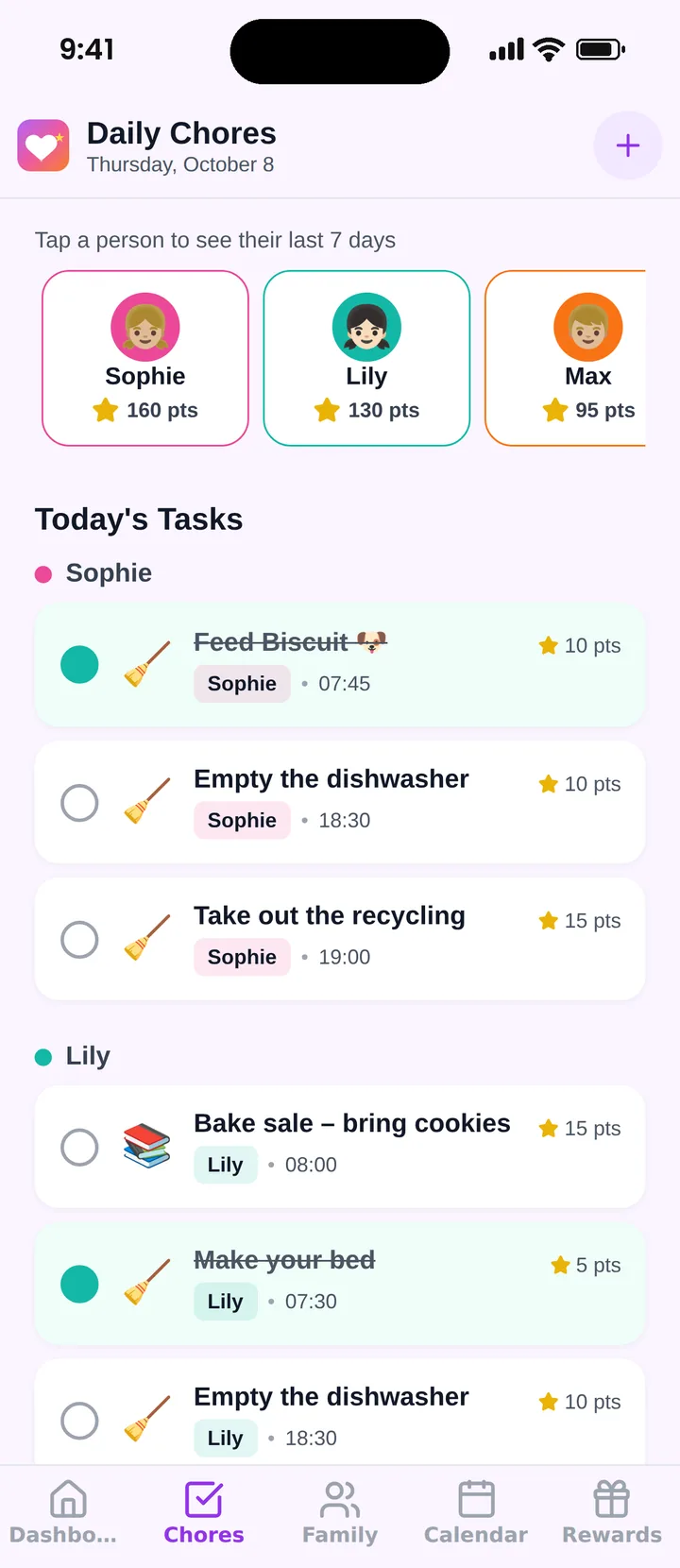
Famiyo is a free family app for iPhone and Android that combines a shared family calendar, chores with points and a rewards shop; kids join with a code, no email needed. Where a magnet chart handles one fixed list, the app handles repeating chores, so a task like "feed the cat" comes back every day without any resetting. Each child sees their own chores and points on their own phone, finishing a task earns points, and a parent can either let kids check it off or approve it. Kids get a notification about a new task, you hear when a chore is done, and every phone stays in sync live.
If you want to see how this compares with other tools, read our list of the best chore chart apps.
A sensible way to decide
Start with the chart if your children are young and your chores are few. If you catch yourself rebuilding it every Sunday, or the fridge door has become a graveyard of lost magnets, that is the sign to move on.
Frequently asked questions
Do magnetic chore charts work for kids?
They work well for younger children with a short, unchanging list, because the physical act of moving a magnet gives a clear sense of finishing. They work poorly once chores change weekly or the child stops looking at the fridge.
What age is a magnetic chore chart best for?
Ages 3 to 8 get the most out of one. Preschoolers can use picture magnets without reading, and early readers enjoy the tactile routine. By 10 or so, most kids find them babyish.
Do magnetic chore charts stick to every fridge?
No. Stainless steel fronts and some newer finishes are weakly magnetic or not at all. Test a refrigerator magnet before you buy. If it barely holds, hang the chart on a metal board or a magnetic whiteboard instead.
What can I use instead of a magnetic chore chart?
A printed weekly chart, a whiteboard, a chore wheel or a family app all work. Choose by the problem you need to solve: forgetting, fairness between siblings, or keeping score with points.
Try Famiyo With Your Family
Chores with points, a rewards shop for kids and one shared family calendar. Set it up in a couple of minutes.



Free to download • No credit card required • Available on iOS & Android