Non-Food Rewards for Toddlers: 40 Ideas That Work
Forty non-food rewards for toddlers ages 1 to 3, from bubbles to a ride on your shoulders, plus how fast to give them and what to say.
By Famiyo Editorial Team5 min read
A toddler cleans up three blocks and you want to say thank you in a way that sticks, ideally without reaching for the snack drawer. This list gives you forty rewards that cost little or nothing, sorted by what the toddler actually wants in that moment, plus the timing and wording that make them work.
Why toddlers do better with non-food rewards
Food rewards are easy, and they work for about a week. Then you are negotiating over crackers every time you leave the house. Public health guidance on children's eating, from groups like the CDC and the American Academy of Pediatrics, generally steers families away from using sweets or snacks as prizes, because it can teach children to value treats more and to eat when they aren't hungry.
There is a second reason. What a toddler wants most is you. Your attention, your voice, your lap, a game that only happens when you are playing it. A reward made of that is cheap, always available, and it never runs out in the cupboard.
What makes a toddler reward work
Three things matter more than which reward you pick.
- Speed. The reward arrives within a few seconds of the behavior. A toddler's sense of "before" and "after" is short, so a prize at dinner for a good morning is just a nice surprise, not a lesson.
- Size. Small and repeatable beats big and rare. A high five works ten times a day. A trip to the zoo works once.
- Words. Name the behavior in a short sentence: "You put the cup in the sink. Thank you!" That sentence does more teaching than the reward does.
Keep the target behavior narrow too. "Be good" is too wide. "Put toys in the bin" or "sit on the potty for a song" is something a two-year-old can understand.
40 non-food rewards for toddlers, by type
Pick a few that suit your child, not all forty. Toddlers lose interest in a reward that appears every time, so rotate.
| Type | Ideas |
|---|---|
| Attention and touch | A big hug, a high five, a piggyback ride, being tossed gently onto the couch cushions, a song just for them, a tickle round, a "wow" face, a turn sitting in your lap for one extra book, a secret handshake |
| Active play | A dance party for one song, blowing bubbles, chasing games, a pillow fort, kicking a ball outside, a stomp in a puddle, a swing at the park, a ride in the stroller or wagon for fun |
| Small privileges | Choosing the bedtime book, picking which cup or spoon to use, choosing the song in the car, choosing which pajamas, being the one to press the elevator button, flipping the light switch, turning the page |
| Little things to hold | A sticker, a stamp on the hand, a new crayon, a tiny toy from a "treasure box", a ribbon to wave, a temporary tattoo, a bath toy, a pom-pom for a jar |
| Special time | Five minutes of one-on-one play with your phone put away, a walk to look at trucks, a trip to feed the ducks, playing with water at the sink, a call to grandma, painting with only water on the patio, a bath with extra bubbles |
That is 40 in total, and almost none of them cost a dollar. For more, see our list of free rewards for kids, and the older-child version of this page, non-food rewards for kids.
Rewards by age within the toddler years
Toddlers change fast, so the same prize will not fit a 14-month-old and a 3-year-old.
Ages 1 to 2. Stick to immediate, physical, social rewards: a cheer, clapping, a hug, a bubble. There is no chart at this age. At best, a sticker works as a happy object, not as a point.
Age 2 to 3. You can add small choices ("Red cup or blue cup?") and a short ritual, like a dance after cleanup. A sticker on a card starts to mean something, though the link to the behavior is still shaky.
Age 3. A chart with three to four boxes is possible. Pair each filled box with a small reward from the table, and a larger reward when the row is full. Keep the row short. A toddler who has to wait ten days has already forgotten why.
What to say when you give the reward
Praise that names the action works better than "good job". Here are phrases you can borrow, and a few more in our guide to positive reinforcement phrases for kids.
- "You shared the truck. Your friend is smiling."
- "You waited. That was hard, and you did it."
- "You put your shoes by the door. Thank you."
- "You sat on the potty and tried. High five!"
Say it with your face down at their level and your phone away. A short, warm sentence is enough.
Things that backfire
- Offering a reward mid-meltdown. The toddler learns that crying produces bubbles. Wait for calm, then reward the calm.
- Using a screen as the default prize. It is easy to reach for, and it is hard to keep small. For ages 2 to 5, the AAP guidance is about an hour of quality programming a day, ideally watched together, so a screen reward eats into that limit fast.
- Taking a reward back. Once given, it stays given. Toddlers can't connect a later consequence to an earlier prize.
- Rewarding everything. If every cup in the sink earns a sticker, the sticker loses meaning within days. Keep rewards for new or hard behaviors and let familiar ones fade into plain thanks.
A sample toddler reward day
Here is how a two-and-a-half-year-old's day could look, with the reward matched to the moment.
- Puts pajamas in the hamper: a cheer and a high five.
- Brings the plate to the counter: choose the song for the car ride.
- Puts three toys in the bin: one round of bubbles.
- Waits at the crosswalk holding your hand: a game of "red light, green light" on the way.
- Tries the potty: a sticker on the door chart and a song.
- Gets in the bath without a fight: choose which bath toy goes in first.
Nothing here costs money, and nothing needs to be saved up.
When rewards start to matter more
As kids grow past three, a points-based system can take over, where each task earns points and points buy rewards. If you want a plan for older children, see our guide to kids reward ideas by age.
Doing this with Famiyo
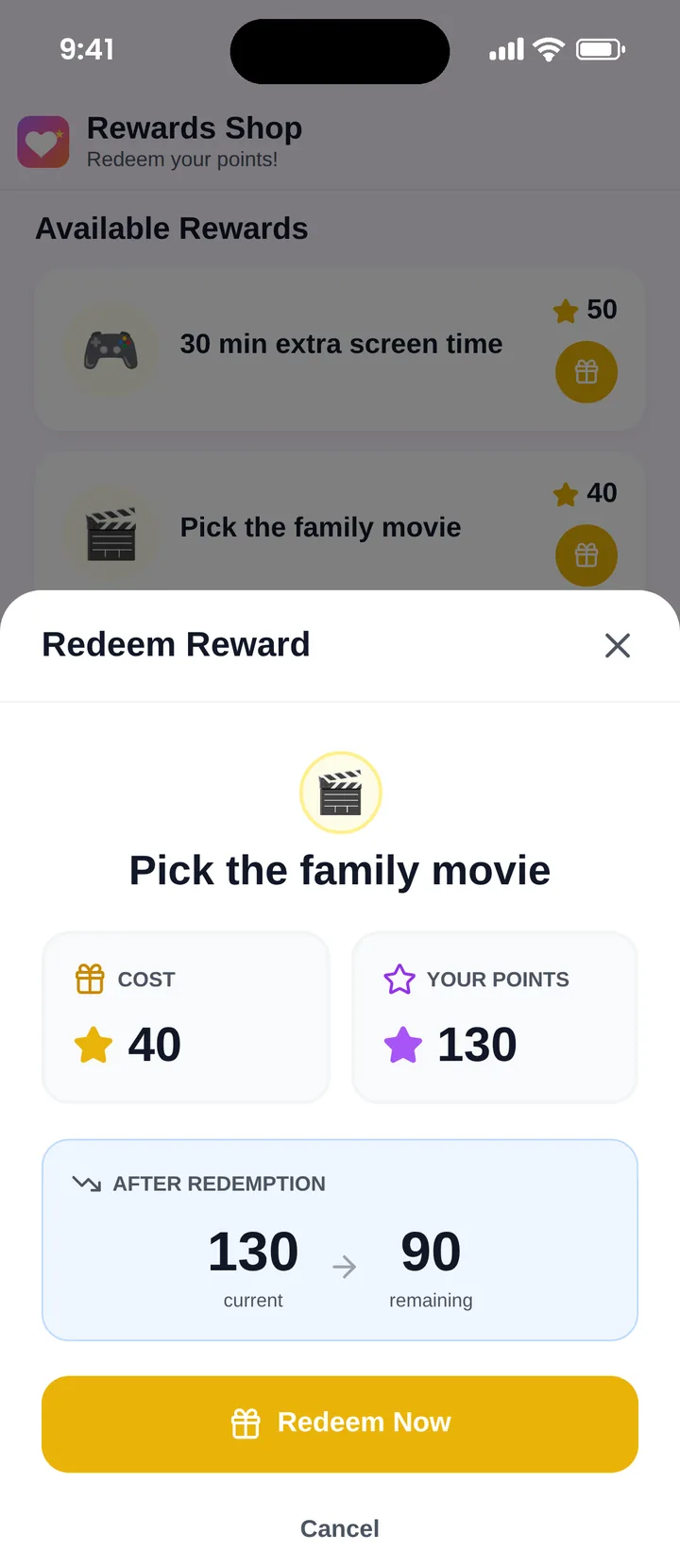
Famiyo is a free family app for iPhone and Android that combines a shared family calendar, chores with points and a rewards shop; kids join with a code, no email needed. A toddler won't use it, but an older sibling will, and you can run the toddler's side yourself. Add rewards such as "pick the bedtime book" or "extra park time" to the shop with a price in points, how many are available and when. Kids redeem from their own phone and see how many points they have left, and you get a notification when they do. Browse our list of the best reward chart apps for kids to compare options.
Start tomorrow with one behavior and one reward from the table. Say what they did, deliver the prize in under five seconds, and watch what happens.
Frequently asked questions
Why avoid food as a reward for a toddler?
Using sweets as a prize can teach a child to want treats more and to eat for reasons other than hunger. Pediatric and public health guidance generally steers families toward non-food rewards. Attention, play and small privileges do the same job without that side effect.
How soon should a toddler get the reward?
Within a few seconds. A toddler links a reward to what happened right before it, so a sticker at bedtime for a good morning means nothing to them. Give the reward at the moment, say what they did, then move on.
Are stickers okay, or are they a bribe?
Stickers are fine as a small, predictable reward when the behavior has already happened. A bribe is offered in the middle of a meltdown to make it stop. Decide the reward in advance and give it after the behavior, not during the tantrum.
Is screen time a good toddler reward?
It is not the best choice. The American Academy of Pediatrics advises avoiding screens other than video chatting under 18 months and keeping to about an hour of quality programming for ages 2 to 5, ideally watched together. Choose active rewards first.
At what age can a reward chart work?
Around age 3, many children can follow a simple chart of three or four boxes and a reward at the end. Before that, rewards need to be immediate and tied to you, not to a chart.
Try Famiyo With Your Family
Chores with points, a rewards shop for kids and one shared family calendar. Set it up in a couple of minutes.



Free to download • No credit card required • Available on iOS & Android