Non-Food Rewards for Kids: Ideas by Size, With Point Prices
Non-food rewards for kids that work at home: time, privileges, outings and small treats, with point prices so you can build a reward menu.
By Famiyo Editorial Team4 min read
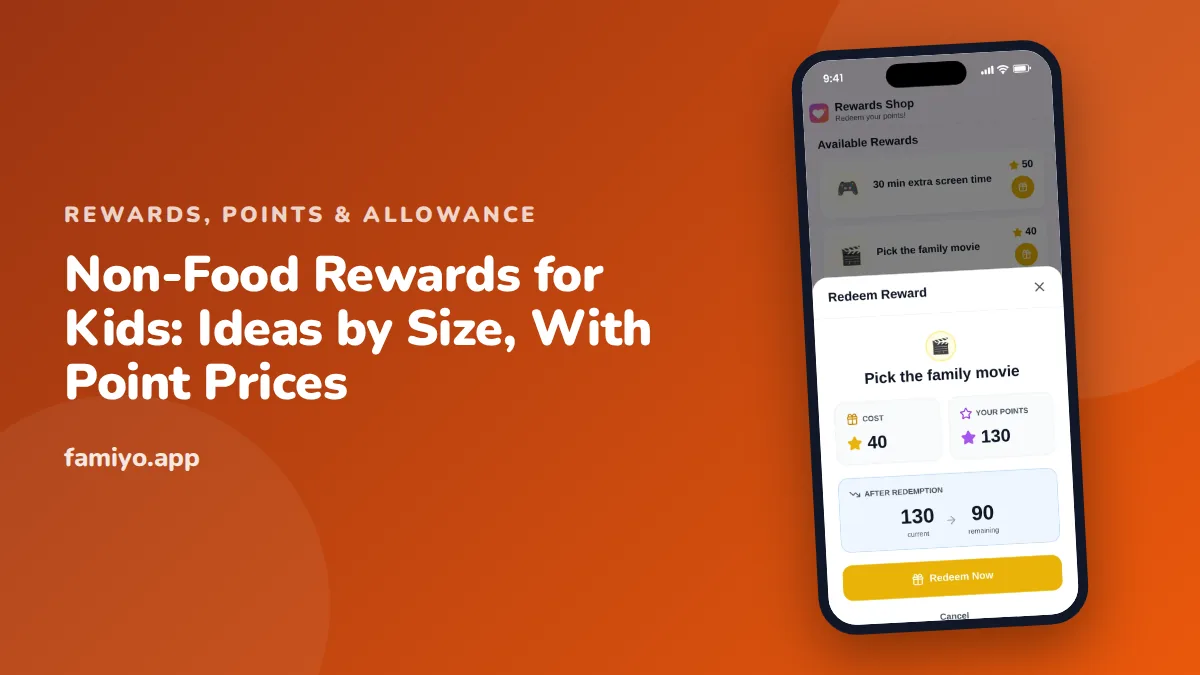
Sweets are easy. They're in the pantry, they work in the moment, and every kid wants them. But when a cookie becomes the standard prize for everything from homework to a haircut, it's hard to unwind. Pediatric and nutrition guidance, including from the American Academy of Pediatrics, generally advises against using food as a reward. This list gives you plenty of alternatives, sorted by size, with price tags you can use.
How to choose a reward that fits
Rewards work best when they're matched to the effort. A tiny task gets a tiny prize. A month of consistent effort gets something you can look forward to.
Research on motivation also suggests a caution: rewarding activities a child already enjoys, such as drawing or reading for fun, can lower their interest over time. Save rewards for tasks that are useful but not fun, like chores and routines. For the things your child loves already, a kind word is plenty. Our guide to intrinsic motivation examples for kids goes deeper on this.
Two other points. Let your child help choose, because a reward they picked means more. And change the menu now and then, since a prize that was exciting in January is dull by March.
Small rewards (30 to 50 points)
These suit quick wins and everyday effort. Many cost nothing, and our list of free rewards for kids has more.
- 15 extra minutes of screen time
- Choosing the family's after-dinner activity
- Picking the bedtime story or an extra one
- Choosing the music in the car
- A special sticker or temporary tattoo
- Sitting in the front seat of the car (where legal and safe for their age)
- Ten minutes of one-on-one play
- Choosing which game the family plays
- Drawing on the driveway with chalk
- Wearing pajamas all day on a Saturday
Medium rewards (about 100 points)
These suit a few days of steady effort.
- Pick the family movie
- Stay up 30 minutes later
- A trip to the playground or park
- Have a friend over for an hour
- A new library book or a visit to pick some out
- A baking afternoon (the activity, not the treat)
- Building a blanket fort and a flashlight story
- Choosing dinner from a list of two
- A bubble bath with candles (LED ones for small kids)
- A pillow fight with a parent, five minutes
Big rewards (300 to 500 points)
These take a few weeks to earn, and that's the point. Waiting and saving is a skill, and our article on delayed gratification activities for kids shows how to build it.
- A day out: zoo, trampoline park, mini golf, bowling
- A small toy or craft kit, around $20
- A sleepover with a friend
- A special one-on-one date with a parent
- A camping night in the backyard
- A new book series or art supplies
- Choosing a family weekend activity
- A donation to a cause they pick
Rewards that cost nothing
Some prizes are a privilege rather than a purchase.
| Reward | Why it works |
|---|---|
| A job swap ("skip one chore") | Gives them control of their time |
| Being the "boss" of the evening | Choosing dinner order or seating |
| Staying up late to stargaze | Rare, memorable |
| A note or call to a grandparent | Builds connection |
| A turn picking the weekend plan | Respect for their opinion |
Rewards to be careful with
A few rewards cause trouble.
- Sweets and snacks, for the reasons above.
- Large cash payments for behavior. Money has a place in paid chores, but not as a fix for every problem.
- Anything you can't deliver. If you promise a trip and then can't go, trust takes a hit.
- Rewards that cancel themselves out, such as "extra screen time if you finish reading."
Matching rewards to the child
Kids differ, and the same prize lands differently. A child who craves attention will value one-on-one time above any object. A child who loves independence may prefer a privilege, like choosing their own bedtime book or deciding the order of the evening. A collector wants the small item. A very active child may care most about outings.
Watch what your child asks for unprompted, and what they talk about at dinner. That's your best guide. If a reward gets a shrug the first time it's offered, drop it from the menu without a lecture. Also keep the effort fair: a reward that takes three weeks to earn should be one your child still wants in week three.
How to build a reward menu
- List ten rewards your child actually likes. Ask them.
- Sort them into small, medium and big.
- Put a price on each in points, using the ranges above.
- Aim for a child to afford a small reward every 2 to 3 days, and a big one every 3 to 4 weeks.
- Review the menu together every few weeks and swap out anything stale.
A reward menu in Famiyo
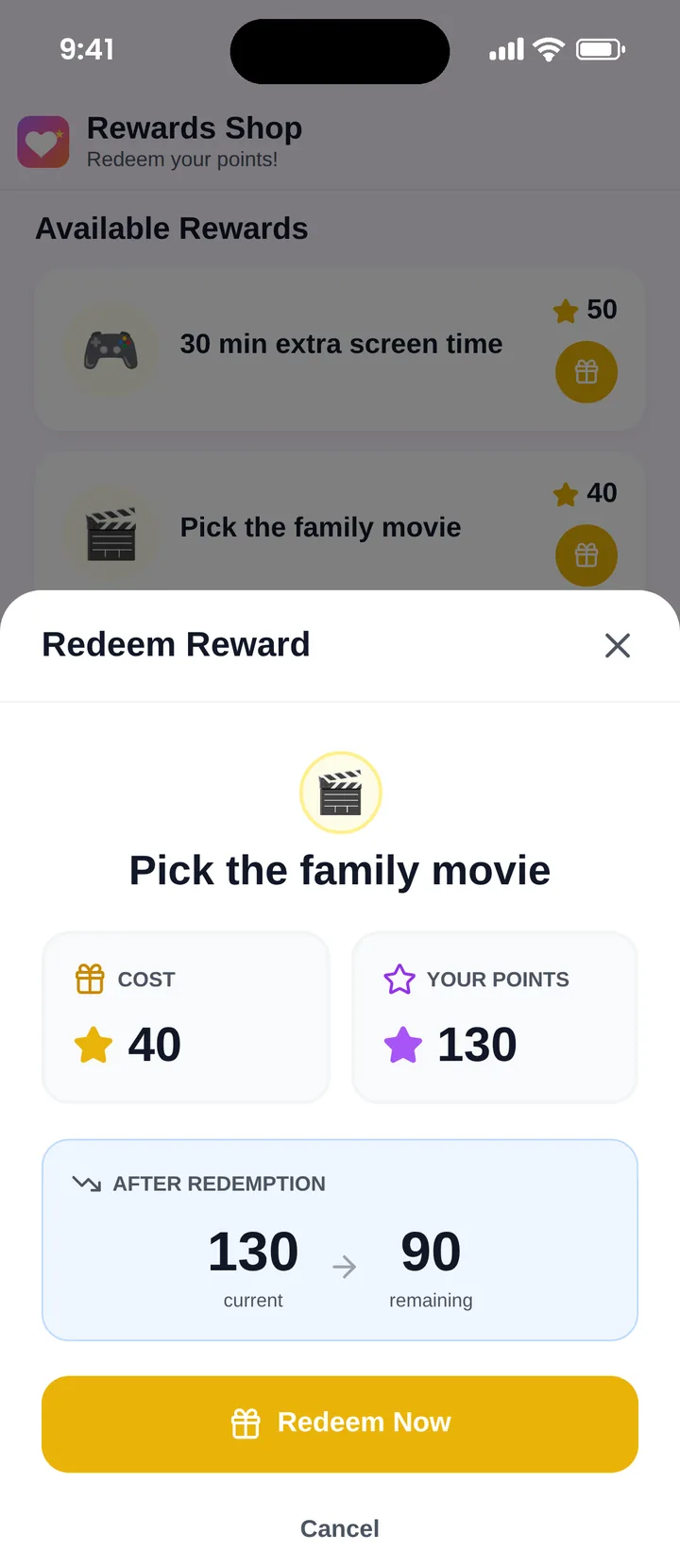
Famiyo is a free family app for iPhone and Android that combines a shared family calendar, chores with points and a rewards shop; kids join with a code, no email needed. The rewards shop is the menu above, made real. You create each reward with a price in points, how many are available and when they can be claimed, so "movie night" can be limited to weekends. Your child opens the shop on their own phone, redeems a reward and sees how many points they'll have left. You get a notification when they do. Our ranking of the best reward chart apps for kids compares your options.
A good first step
Sit down with your child this week, list ten rewards and let them pick their favorite from each size. That's your first menu.
Frequently asked questions
Why avoid food as a reward for kids?
Pediatric and nutrition guidance, including from the American Academy of Pediatrics, generally advises against using food as a reward, because it can link eating with emotions instead of hunger. Non-food rewards avoid that and work just as well.
What is a good non-food reward for a small win?
Something quick that costs nothing: choosing the music in the car, 15 extra minutes of play with you, picking the bedtime story, or a high five and a special sticker. Small wins deserve small rewards.
Are screen time rewards a good idea?
They can be, if you keep them in proportion. The AAP recommends consistent family limits for school-age children, so a bonus of 15 minutes works better than an open-ended hour. Offer other rewards too, so screens aren't the only prize.
How do I stop rewards from becoming bribes?
Agree on the reward before the task, not during a meltdown. A bribe appears after the behavior goes wrong. A reward is part of a plan your child knows in advance, tied to a clear goal.
Try Famiyo With Your Family
Chores with points, a rewards shop for kids and one shared family calendar. Set it up in a couple of minutes.



Free to download • No credit card required • Available on iOS & Android