Positive Reinforcement for Kids: 30 Examples by Situation
30 positive reinforcement examples for kids, sorted by type and by everyday situation (mornings, homework, siblings, bedtime), plus when it backfires.
By Famiyo Editorial Team5 min read
Positive reinforcement has a plain definition: something pleasant follows a behavior, and the behavior becomes more likely. That's it. The tricky part is knowing what counts as pleasant to your particular child, and delivering it at the right moment. This list gives you 30 examples sorted by type, then a second pass by everyday situation, with the words to use and the ways it goes wrong.
The American Academy of Pediatrics, in its guidance on discipline, advises parents to notice and reward the behavior they want to see rather than only react to what they don't. What follows is a practical version of that advice.
The five types of positive reinforcement
Most examples fall into one of five groups. It helps to know which one you're reaching for, because they suit different ages and different jobs.
| Type | What it looks like | Best for |
|---|---|---|
| Social | Specific praise, a hug, a high five, telling the other parent in front of your child | Every age, every day |
| Activity | Reading together, a game of catch, choosing the music in the car | Ages 2 to 12 |
| Privilege | Staying up 30 minutes later, picking the family movie, choosing dessert | Ages 5 and up |
| Tangible | A sticker, a small toy, a trip somewhere | Tougher habits, short bursts |
| Token | Points or stickers saved up and exchanged for a reward | Ages 4 and up, repeating habits |
Social examples
- "You put your plate by the sink without me asking. Thank you." (Name the exact action.)
- A high five the second a hard task is finished.
- Telling your partner in front of your child: "Guess who fed the dog today?"
- A note in the lunchbox: "You cleaned up the blocks yesterday. I noticed."
- A thumbs-up across the room when they use words instead of yelling.
Activity examples
- Ten extra minutes of a bedtime story.
- Choosing the song for the car ride.
- A bike ride or a walk with one parent, no siblings.
- Helping you cook something they pick.
- A game of cards after homework is finished.
Privilege examples
- Picking the family movie on Friday.
- Staying up 30 minutes later on a weekend.
- Choosing dessert tonight.
- Picking where the family eats on Saturday.
- Fifteen extra minutes of screen time.
Tangible and token examples
- A sticker on a chart for each finished morning routine.
- A small book or toy for a long streak.
- A trip to the park for finishing a week of chores.
- Points for each task, saved toward a bigger reward.
- A day out once the points add up. Our guide to point system rewards for kids explains how to price these.
If you want prizes that won't end up under the couch, see prizes for kids that aren't junk.
Examples by everyday situation
Behavior happens in the middle of life, so here is how the same tools look in the moments that tend to go wrong.
| Situation | What to reinforce | What to say or give |
|---|---|---|
| Morning | Getting dressed before breakfast | "You're dressed already, so we have time for a quick card game." |
| Homework | Starting without a reminder | A short break picked by the child, plus "You started on your own." |
| Siblings | Sharing, asking nicely | "I saw you give her the blue marker. That was kind." Then a few minutes with you. |
| Mealtime | Trying one bite of a new food | Praise for trying, not for finishing. No dessert bribes. |
| Cleanup | Putting toys away | "All the blocks are in the bin!" plus a sticker for a toddler. |
| Bedtime | Staying in bed | A sticker in the morning and a cheerful "You stayed in bed all night!" |
Notice the pattern: you describe what happened and attach something small and quick.
What makes it work (and what breaks it)
Research on reinforcement agrees on a handful of basics, and none of them are complicated.
Timing matters most. Reinforce within seconds for toddlers and within the same day for school-age kids. Be specific: "Good job" tells a child almost nothing, while "You waited your turn even though you were frustrated" tells them what to repeat. Start with something frequent and small, then thin it out as the behavior becomes automatic.
Here is where it goes wrong:
- Rewarding too much, so the reward loses its pull and becomes expected.
- Switching to rewards for things a child already enjoys. Children who love drawing can lose some of that love if every drawing earns a prize. Keep rewards for chores and habits, not passions. For the words themselves, see our list of positive reinforcement phrases for kids.
- Bribing in the moment ("If you stop screaming, I'll buy you a toy"). That reinforces the screaming.
- Taking earned rewards back. Handle misbehavior separately.
- Praising the child as a person ("You're the best") instead of the effort ("You kept trying").
How a child responds also depends on the child. Some kids glow with public praise, others find it embarrassing and prefer a quiet word. If your child has ADHD, autism or strong oppositional behavior, a pediatrician or therapist can help you tailor the approach to your child.
Tying examples to a chart
For habits that repeat daily, a visual chart gives the reinforcement structure, and a points system lets kids choose what they work toward. Choice is itself a reinforcer: a child who picks the reward cares more about earning it. Build in some quick wins so the first reward arrives within 2 to 3 days, and save bigger rewards for a few weeks out.
Running rewards in Famiyo
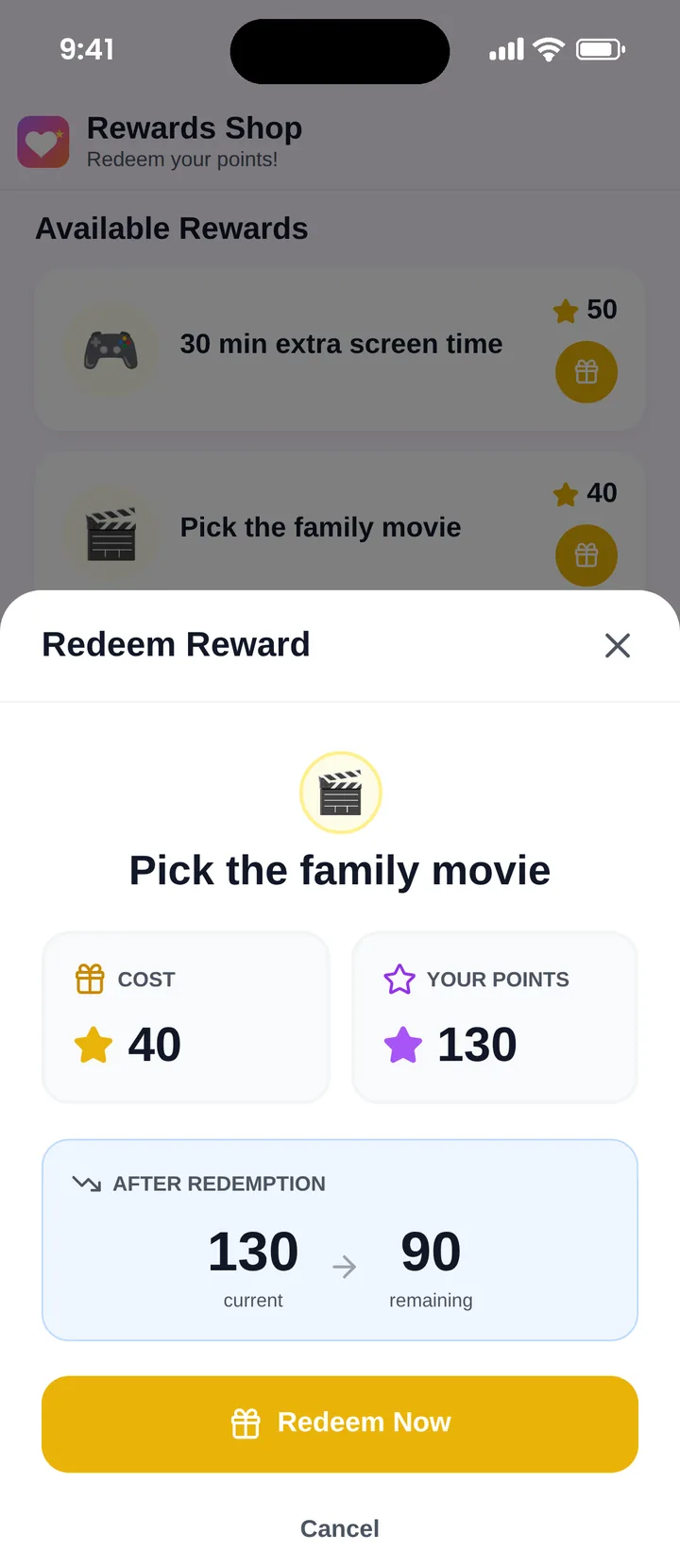
Famiyo is a free family app for iPhone and Android that combines a shared family calendar, chores with points and a rewards shop; kids join with a code, no email needed. For positive reinforcement it works like this: you give chores points as kids finish them, then you build a rewards shop with the examples above. Each reward has a price in points, a limit on how many are available and a date range. Kids redeem from their own phone and see how many points they'll have left, and you get a notification when they do. Browse our list of the best reward chart apps for kids if you're comparing options.
Pick three examples from this list that fit your child, use them for a week, and see which ones they ask for again.
Frequently asked questions
What is an example of positive reinforcement for a child?
Your 6-year-old packs their school bag without being asked, and you say, 'You packed your bag all by yourself, that makes our morning easier,' then give a high five. The child hears exactly what earned the attention, so packing the bag becomes more likely tomorrow.
Is positive reinforcement the same as bribing?
No. A reinforcer comes after the behavior and was agreed in advance, like 'When homework is done, we play a game.' A bribe is offered in the middle of a meltdown to make it stop, which teaches the child that meltdowns pay.
Does positive reinforcement have to be a reward or treat?
No. Attention, praise, time together and choices are the most common reinforcers and cost nothing. Tangible rewards and points are useful for tougher habits, but most daily good behavior is best met with specific words and a warm response.
How soon should I reinforce a behavior?
As close to the behavior as you can. For toddlers that means seconds, for school-age kids within the same day. The longer the gap, the weaker the link between what the child did and what they got.
Try Famiyo With Your Family
Chores with points, a rewards shop for kids and one shared family calendar. Set it up in a couple of minutes.



Free to download • No credit card required • Available on iOS & Android