Point System Rewards for Kids: What to Offer and What to Charge
Which rewards to put in a kids' point system, how many points each should cost, and how to keep the prices fair as your child earns more.
By Famiyo Editorial Team4 min read
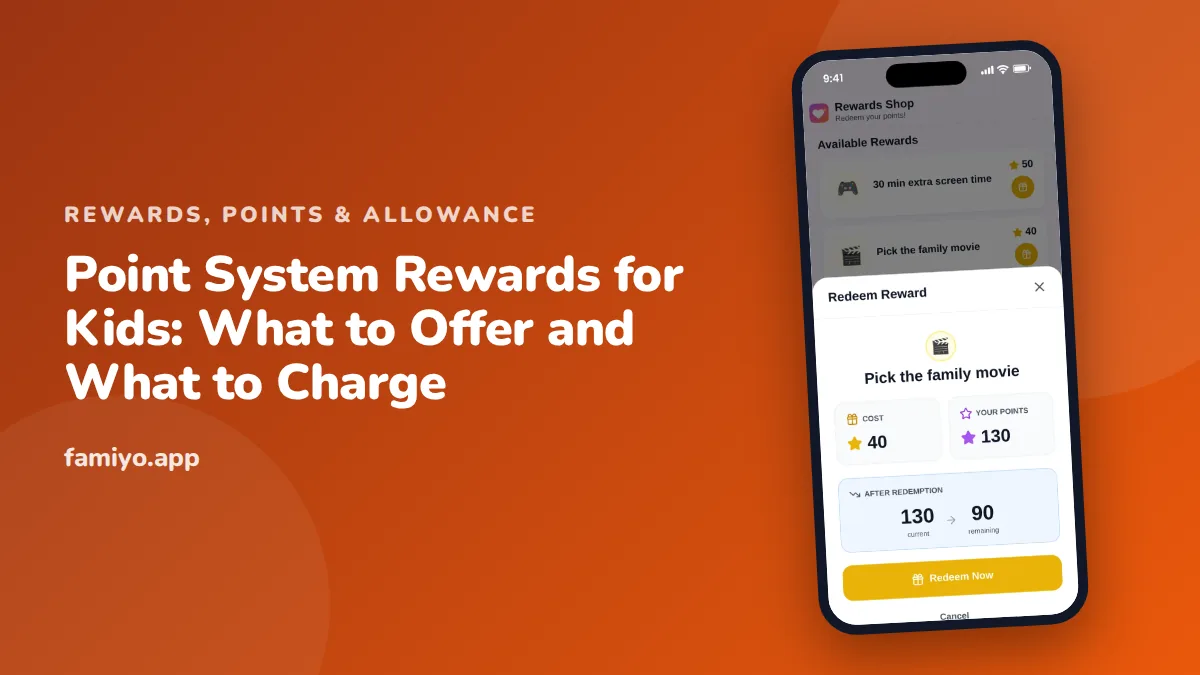
Most articles about point systems spend their time on how to earn points. This one is about the other side: what the points buy. A reward menu that kids want, priced so it feels fair, is what keeps a point system running after the novelty fades. Below is a priced list of reward ideas, a quick way to set the numbers, and the common mistakes that drain a system of meaning.
Why the reward menu matters more than the chore list
Child development researchers have long described how rewards reinforce behavior when they follow it closely and when the child values them. A reward the child shrugs at does nothing, however clever the chore chart is. That is why the menu deserves as much thought as the tasks.
The American Academy of Pediatrics encourages parents to lean on praise, attention and clear expectations first, and to treat prizes as an extra. A good menu respects that: lots of low-cost, time-based options and a few bigger goals. Whether a reward helps or backfires also depends on the child, so watch what actually gets them excited.
How to price rewards in points
Start with how many points your child earns in a week, then price the menu so progress is visible.
| Task size | Example | Points |
|---|---|---|
| Small (2 to 5 minutes) | Make the bed, feed the pet | 5 |
| Medium (10 to 15 minutes) | Empty the dishwasher, tidy the room | 10 |
| Big (30 minutes or more) | Clean the bathroom, mow the lawn | 20 |
| Bonus | Done without a reminder | +2 |
| Reward size | Examples | Price |
|---|---|---|
| Small | 15 extra minutes of screen time, choose dessert | 30 to 50 points |
| Medium | Pick the family movie, stay up 30 minutes later | 100 points |
| Big | A day out, a toy around $20 | 300 to 500 points |
Aim for a child to afford a small reward every 2 to 3 days and a big one every 3 to 4 weeks. If a 9-year-old earns about 15 points a day, that works out to around 100 points a week, so a 40-point reward is within reach by mid-week and a 400-point goal takes about a month. If you convert points to money, the rate is 100 points to $1.
30 rewards to put in the shop
Mix the types. Kids go for different things at different ages.
Small (30 to 50 points)
- Choose dessert or the family snack for a night
- 15 extra minutes of screen time
- Pick the music in the car
- Skip one small chore
- Choose the bedtime story
- Have breakfast in a fancy cup
- Extra 10 minutes of playtime with a parent
Medium (around 100 points)
- Pick the family movie
- Stay up 30 minutes later on a weekend
- Invite a friend over for an hour
- Choose what's for dinner
- Bake something together
- Have a picnic in the living room
- One hour of one-on-one time with a parent
Big (300 to 500 points)
- A day out, such as the zoo or a trampoline park
- A toy around $20
- A friend sleepover
- A trip for ice cream with one parent
- A new book series
- A craft or Lego kit
- Choose a family weekend activity
Money and savings (for older kids)
- $1 for every 100 points
- Matching bonus on money they save
- A contribution toward a bigger goal, such as a game or sports gear
Our ideas for older ages are in kids reward ideas by age, and if you want to avoid candy, see non-food rewards for kids.
Experiences or things?
If you can, put time and experiences first. They are cheaper, they don't pile up in the bedroom, and they tie the reward to a relationship. The trick is to make those experiences specific. "One hour of one-on-one time, your choice of activity" is clearer, and more attractive, than "special time."
If you use objects, keep them useful and avoid disposable prizes. Our list of prizes for kids that aren't junk has ideas that last longer than a week.
Rewards that cause trouble
- Rewards you can't deliver. Never list a trip you aren't ready to take. A broken promise costs more than a missing prize.
- Rewards that clash with rules. If a screen rule says no phones after dinner, don't sell "phone after dinner" in the shop.
- Rewards that are too cheap. If everything costs 5 points, nothing feels earned.
- Rewards that are too far. A 1,000-point goal is a month of waiting for a child who earns 10 a day. Add a mid-way reward.
- Rewards you give for free. If a child can get the movie pick anyway, they won't pay for it. Keep the shop for things that are truly extra.
Keeping the system fair over time
Rewards that were exciting in week one feel flat by week six. Refresh the menu every month, retire items nobody buys and add one new item your child suggests. As kids earn more, raise the big prices slowly, or add a bigger tier. If you also pay allowance, our allowance vs chore money guide explains how to keep the two from mixing.
For ideas on wording and day-to-day praise, see positive reinforcement examples for kids.
Doing this with Famiyo
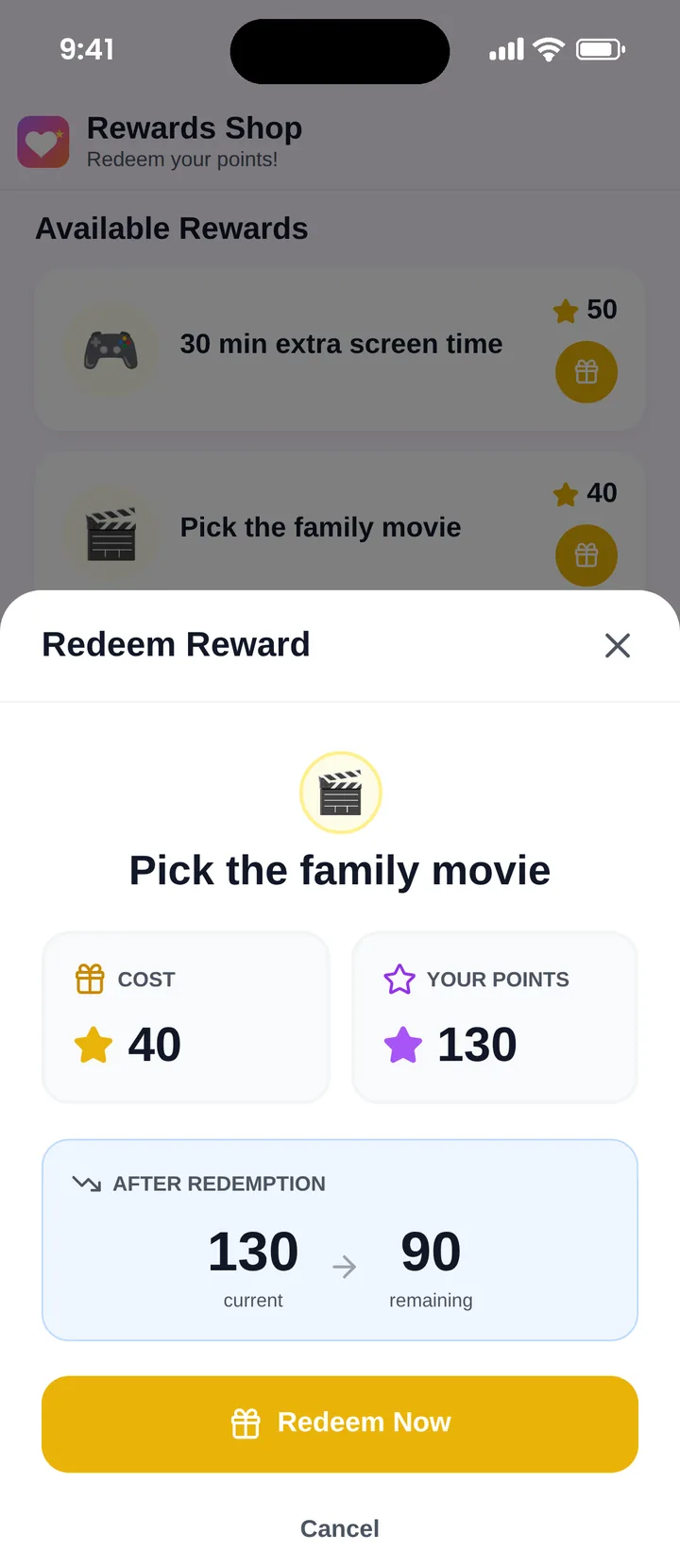
Famiyo is a free family app for iPhone and Android that combines a shared family calendar, chores with points and a rewards shop; kids join with a code, no email needed. The rewards shop is where the menu above lives. You create each reward with a price in points, how many are available and when, so a day out can be limited to once a month. Kids redeem from their own phone, see how many points they will have left, and you get a notification when they do. Pocket money can be one of the rewards, though the money itself changes hands outside the app. See how it compares in our list of the best reward chart apps for kids.
Write down ten rewards tonight, price them with the tables above, and ask your child to cross out two and add two of their own.
Frequently asked questions
What rewards should go in a kids' point system?
Offer a mix of small privileges such as choosing dessert, medium treats such as picking the family movie, and big goals such as a day out. Time with a parent and choices usually motivate better than cheap toys, and they cost less.
How many points should a reward cost?
A common scale is 30 to 50 points for small rewards, around 100 for medium and 300 to 500 for big ones. Set prices so a child can afford a small reward every 2 to 3 days and a big one about once a month.
Should points be converted into money?
You can, using a simple rate such as 100 points equals $1. Do it only if you want the points to become pocket money. Otherwise keep points for non-cash rewards, so the system stays about effort and not about payment.
What if my child saves points and never spends them?
Saving for a big goal is healthy. If points pile up with no purpose, help your child choose a goal, add a time-limited reward, or lower the price of something they want. Hoarding often means the menu does not interest them.
Do points rewards work for teenagers?
Yes, with bigger and more personal rewards: later curfew on weekends, a phone plan upgrade, a night out with friends, or pocket money. Let them help design the menu, because teens resist rewards they had no say in.
Try Famiyo With Your Family
Chores with points, a rewards shop for kids and one shared family calendar. Set it up in a couple of minutes.



Free to download • No credit card required • Available on iOS & Android