Reward System for Kids' Chores: How to Build One That Works
How to design a reward system for chores: what to reward, how to price rewards, when to pay in points versus money, and how to keep it from backfiring.
By Famiyo Editorial Team6 min read
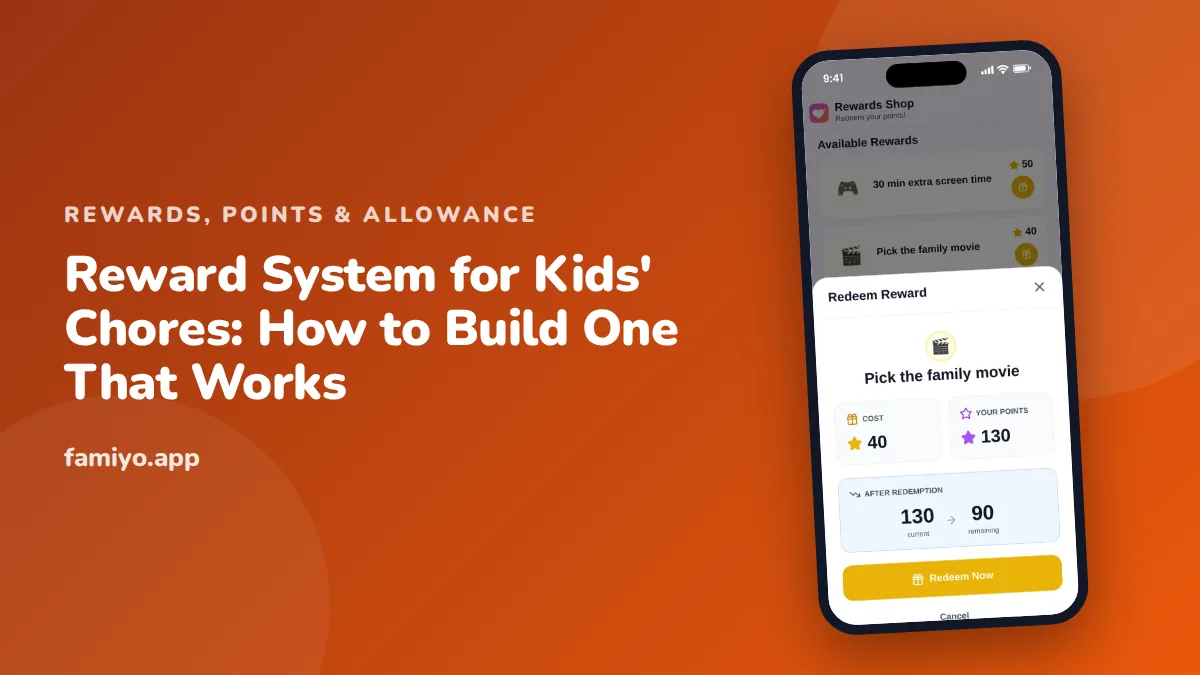
Most reward systems for chores fail for dull reasons. The prizes are too far away, the rules shift, the parent forgets to keep score, or the reward turns into a bribe that has to be bigger every week. A sturdier design is not complicated. It needs a clear list of jobs, a points scale, a menu of rewards with fixed prices, and a few rules about what happens when things go wrong. This guide covers each part, and where the evidence is mixed, it says so.
What the research suggests, and where it is mixed
The popular worry is that rewards "kill" a child's natural motivation. The honest summary is more careful. Psychologists have long distinguished between intrinsic motivation (doing something because it is satisfying or meaningful) and extrinsic motivation (doing it for an outcome). Studies of rewards have found that unexpected, controlling or very large rewards can reduce interest in an activity that a child already enjoyed. Chores are a different case, since most kids don't enjoy them to begin with.
Guidance from bodies such as the American Academy of Pediatrics tends to favor positive reinforcement: noticing and rewarding the behavior you want, rather than relying on punishment. In practice, that points to a few principles that hold across most families.
- Reward specific behaviors, not general "goodness."
- Make the link between the job and the reward clear and quick.
- Pair rewards with real praise, so the child hears why the work mattered.
- Expect to fade the reward as the habit becomes routine.
How well this works depends on the child. Some kids respond strongly to points, others barely care and respond more to attention or choice. If you want the broader picture, our guides to positive reinforcement for kids and what really drives children go further.
Step 1: decide what gets rewarded
Not every task needs a prize. A simple split keeps the system manageable.
| Type of task | Examples | How to treat it |
|---|---|---|
| Core family jobs | Make the bed, clear your plate, put laundry in the hamper | Expected. Points count it, but missing it is not a crisis |
| Regular responsibilities | Empty the dishwasher, feed the pet, pack the school bag | Points every time, tied to a moment in the day |
| Extra jobs | Wash the car, rake leaves, clean out the garage | Bigger points, or a small cash payment, and optional |
The point of the split is that a child can always say no to an extra job, but not to a core one. That keeps the system from turning into "I'll only help if you pay me."
Step 2: price the chores in points
Use a small number of sizes so you never have to think about it. A good default scale follows.
| Task size | Example | Points |
|---|---|---|
| Small (2 to 5 minutes) | Make the bed, feed the pet | 5 |
| Medium (10 to 15 minutes) | Empty the dishwasher, tidy the room | 10 |
| Big (30 minutes or more) | Clean the bathroom, mow the lawn | 20 |
| Bonus | Done without a reminder | +2 |
Points track time and effort, not how much you want the job done. The bonus is the clever part: it pays the exact behavior most parents are after, which is a child who acts without being told.
For how many chores a child should have in the first place, a rule of thumb is 2 to 3 daily tasks for preschoolers and 3 to 4 for school-age kids, adding one weekly big job from about age 8.
Step 3: build the reward menu
The menu is where the system lives or dies. Kids need to see something they actually want, at a price they can reach.
| Reward size | Examples | Price |
|---|---|---|
| Small | 15 extra minutes of screen time, choose dessert | 30 to 50 points |
| Medium | Pick the family movie, stay up 30 minutes later | 100 points |
| Big | A day out, a toy around $20 | 300 to 500 points |
Check the pacing with a quick sum. A child doing four daily tasks at 5 to 10 points earns somewhere around 25 to 30 points a day, which is a small reward every day or two and a medium one most weeks. A big reward should land every 3 to 4 weeks. If a child can never afford anything, the prices are too high. If they can buy everything by Tuesday, they are too low.
A few ground rules for the menu:
- Let the child help choose the rewards. A prize you picked and they don't want is just clutter.
- Prefer experiences and privileges over things. Time with a parent often beats a toy.
- Limit how often something can be redeemed. Screen time, for example, shouldn't be unlimited just because points are.
- Post the prices where everyone can see them.
If you need ideas for a reward that fits a family's money rules, see our pieces on how much to pay kids for chores and the broader point system for kids.
Step 4: pay in points or in money?
Both can work, but they send different messages. Points are flexible and teach saving toward a goal. Money teaches budgeting, but it can turn family help into a transaction.
If you convert points to cash, 100 points equal $1 in the default scale. A reasonable middle route is to keep points for everyday jobs and reserve cash for extras: $0.25 to $1 for a small extra job, $2 to $5 for a big one. A separate allowance is a different thing again, and our guide to allowance by age and whether to pay for chores sorts out the options. Whichever route you pick, say it out loud so your child knows which kind of job is which.
A sample week for a 9-year-old
Say your child has four daily jobs: make the bed (5), pack the school bag (5), set the table (5) and feed the pet (5). That is 20 points a day before any bonus. Add the 2-point no-reminder bonus on three of those jobs and a Tuesday and Thursday dishwasher job at 10 points each, and the week comes to roughly 150 points.
By Wednesday evening they can afford 15 extra minutes of screen time at 40 points. By the weekend they are close to a family movie pick at 100 points. A day out at 300 points arrives in about two weeks of steady effort, which is a long wait at this age, so a halfway milestone, like a favorite breakfast at 150 points, keeps the goal alive. Changing nothing but the pacing is often enough to rescue a system that has gone flat.
Rules that keep a reward system from backfiring
- Never take earned points away as punishment. If points can be lost, kids stop trusting the system. Handle behavior problems separately.
- Don't let a reward replace the explanation. Keep saying why the job matters to the family.
- Keep the rules the same for every child, adjusted for age, so siblings don't feel cheated.
- Review after 2 to 3 weeks. A new routine needs that long before you can judge it, and you can adjust prices then.
- Fade slowly. Once a job is automatic, drop its points or move it to the "expected" tier, and put the effort into a new one.
When a child stops caring about points, that's usually a pricing or novelty problem, not a character flaw. Refresh the menu with new rewards before you increase the pressure.
Running the reward shop in Famiyo
Famiyo is a free family app for iPhone and Android that combines a shared family calendar, chores with points and a rewards shop; kids join with a code, no email needed. The rewards shop is where this guide's menu lives. You create each reward with a price in points, how many are available and when. Your child opens it on their own phone, picks a reward and sees how many points they will have left before confirming. You get a notification when a reward is redeemed.
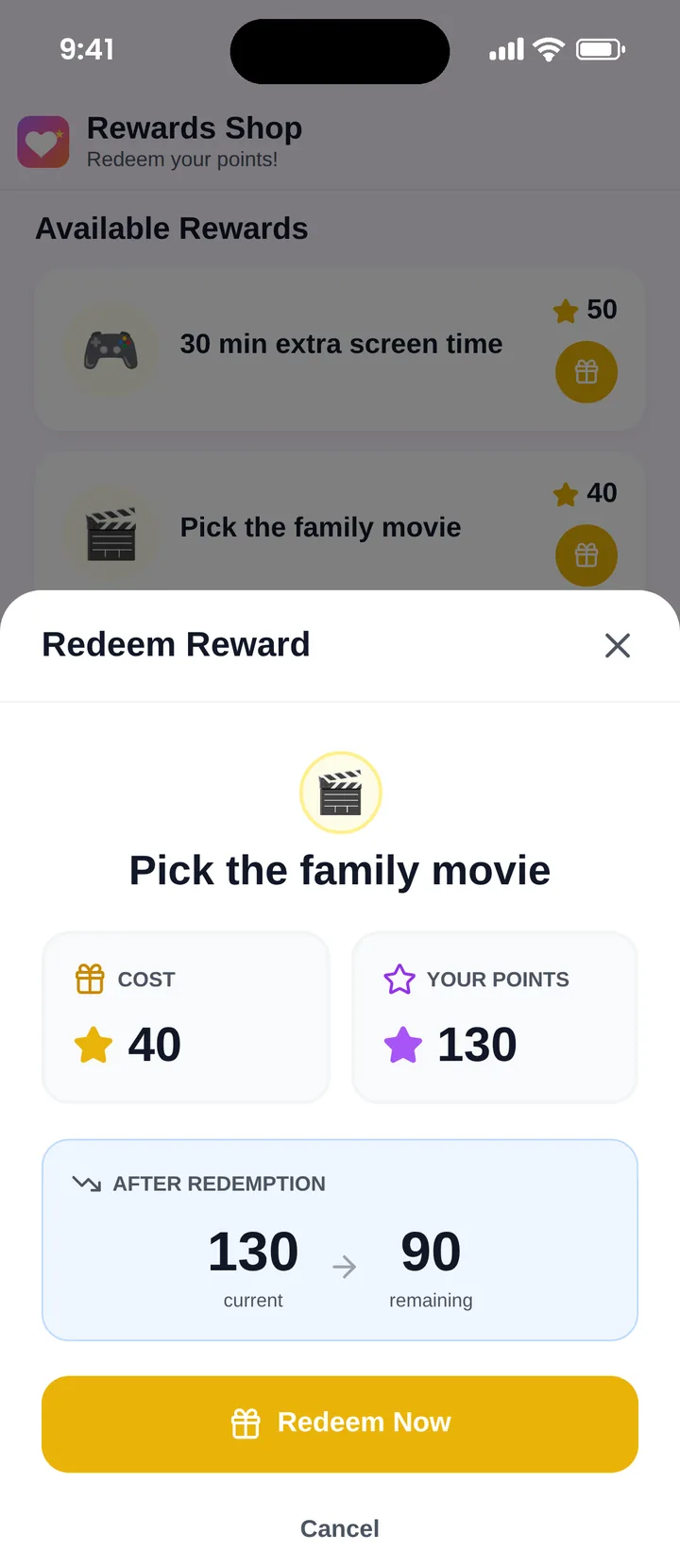
Money never moves through the app, so a pocket-money reward is still handed over outside it. If you're comparing tools, our ranking of the best reward chart apps for kids is a good place to start.
Write down your small, medium and big prices this week, and ask your child to add one reward to each tier.
Frequently asked questions
What is a good reward system for chores?
Points for each chore, a menu of rewards with set prices, and a rule that points are earned on the job and spent later. Small rewards cost 30 to 50 points, medium ones 100, big ones 300 to 500. Keep prices posted and don't change them mid-week.
Do rewards for chores hurt intrinsic motivation?
They can, mostly when a reward is unexpected and then stops, or when a child feels controlled by it. Research on motivation points toward using rewards to start a habit, pairing them with praise, and fading them as the habit takes hold. It depends on the child.
What are good non-food, non-money rewards for chores?
Extra screen time, picking the family movie, choosing dessert, staying up 30 minutes later, a trip to the park or a day out with one parent. Experiences and privileges tend to last longer than small toys and don't cost much.
How many points should a chore be worth?
A common scale is 5 points for a small task of 2 to 5 minutes, 10 for a medium one of 10 to 15 minutes, and 20 for a big one of 30 minutes or more, with 2 bonus points for doing it without a reminder.
Try Famiyo With Your Family
Chores with points, a rewards shop for kids and one shared family calendar. Set it up in a couple of minutes.



Free to download • No credit card required • Available on iOS & Android