Reward System for Kids With ADHD: What Works and Why
A reward system for kids with ADHD works best when rewards are small, immediate and visible. Here is how to set one up, with point values and examples.
By Famiyo Editorial Team6 min read
A child with ADHD often knows exactly what they are supposed to do. The hard part is starting, staying with it, and caring enough about a reward that shows up on Saturday. This guide explains why standard sticker charts tend to fizzle for these kids and what to change so a reward system holds up on an ordinary Tuesday.
It is a parenting guide, not medical advice. Your child's pediatrician or therapist knows their situation, and the ideas below are meant to fit alongside that care.
Why regular reward charts often fail with ADHD
Many children with ADHD have a hard time with delayed rewards. Waiting a week for a prize that depends on a hundred small choices asks for exactly the skills that are most difficult: planning, working memory and sustained effort. The reward is real, but it is too far away to steer behavior today.
Both the CDC and the American Academy of Pediatrics describe parent training in behavior management as a core part of support for younger children with ADHD. The common thread in that guidance is simple: clear expectations, praise and rewards that come right after the behavior, and consistent follow-through. A chart that pays out on Sunday for something that happened on Monday breaks that thread.
Three other things tend to trip these charts up:
- Too many targets. Eight rows on a chart is a long list for a child who struggles to hold three steps in mind.
- Rewards that go stale. Novelty matters. A prize that thrilled your child in week one may get a shrug in week four.
- Penalties. When points disappear for mistakes, the chart starts to feel like a trap rather than a game.
None of this means a reward system is the wrong tool. It means the design has to match how attention and motivation work for your child.
The five design rules that matter most
Evidence on behavior support for ADHD is fairly consistent, even though every child is different. These are the rules worth building around.
- Immediate beats big. Points or praise within seconds of the behavior do more than a bigger prize later.
- Frequent beats rare. Several small chances to earn each day keep the child engaged.
- Visible beats remembered. The child should see the points or progress, not rely on memory.
- Specific beats general. "Brush teeth before the timer ends" is clear. "Be responsible" is not.
- Positive beats punitive. Earn, don't lose. If a task is missed, the child simply doesn't earn that one.
If you only change one thing about a system that isn't working, shorten the gap between the behavior and the payoff.
What to put on the chart
Pick two or three behaviors, not ten. Choose things your child can actually do today and that you can see happen. Break big tasks into the first small step, since starting is usually the hardest part.
| Goal | What counts | Points |
|---|---|---|
| Morning routine | Dressed and shoes on before the timer ends | 5 |
| Homework start | Sits down and opens the book at the agreed time | 5 |
| Tidy up | Toys in the bin after a 10-minute reset | 10 |
| No reminder bonus | Starts the task without being told | +2 |
| Big job | Helps clean a room for 30 minutes with breaks | 20 |
These numbers follow the common default of 5 points for a small task, 10 for a medium one and 20 for a big one, with a small bonus for doing it without a reminder. Adjust to fit your child, but keep the pattern: small tasks, quick wins.
Put a visual cue next to each one. A photo of the made bed or a three-picture strip for the morning routine does more than a written list, and it keeps your voice out of the nagging role.
Rewards that keep their pull
The reward menu is where many families get stuck. A child with ADHD may lose interest in the same prize quickly, so build a menu with variety and refresh it on a schedule.
Small rewards the child can afford in a day or two (30 to 50 points):
- 15 extra minutes of screen time
- Choosing dessert
- Picking the music in the car
- A 10-minute game with a parent, with the child choosing
Medium rewards (about 100 points):
- Choosing the family movie
- Staying up 30 minutes later on a weekend
- A trip to the park with a friend
Big rewards (300 to 500 points):
- A day out
- A small toy around $20
Aim for the child to afford a small reward every 2 to 3 days. That rhythm fits the need for a short feedback loop. Big rewards still have a place, but treat them as a long-term goal, not the engine of the system.
Experiences often hold interest longer than objects. And watch for rewards that quietly become entitlements, such as daily screen time. If a child gets it regardless, it stops working as a reward.
How to run it day to day
A system this small only works if it is run the same way each day. Here is a simple sequence you can start tonight.
- Sit down with your child and choose two or three behaviors. Let them pick one if possible.
- Show them the reward menu and let them choose what they want to work toward first.
- Say what earns points in one sentence. "When your shoes are on before the timer, that's 5 points."
- Give the points right away, with a short, specific line of praise: "You started without me asking. That's a bonus."
- Let them spend points early in the first week, so they learn that points turn into something real.
- After two to four weeks, sit down again. Retire a behavior that has become automatic and refresh the reward menu.
When a task is missed, keep it flat and short: "That one didn't count today. You get another chance after dinner." No lecture, no lost points.
Pair the chart with a few helpers that reduce the load: a visual timer, a checklist near where the task happens, and a calm lead-in ("Five minutes, then shoes"). The chart rewards the behavior, but these supports make it more likely.
What to do when the chart stops working
It will, at some point. That is normal and not a sign that your child is manipulating the system.
- Check the gap. Is the payout still quick enough? Add a mid-day check-in.
- Check the load. Too many targets is the usual cause. Drop one.
- Check the menu. Swap in two new rewards and take out the two they never choose.
- Check the target. If a task has become automatic, retire it and start a new one.
- Check in with the care team. If a plan has stalled for weeks, tell your pediatrician or therapist. They can help you adjust it.
Compare notes with our guide to a reward system for kids for the general version of these steps, and our article on positive reinforcement for kids for the praise side of the equation. If your child also does chores, the approach in our reward system for chores guide shows how to keep points tied to specific jobs. Families who also support a child with autism may find our reward system for kids with autism useful for the overlap and the differences.
Running the rewards shop in Famiyo
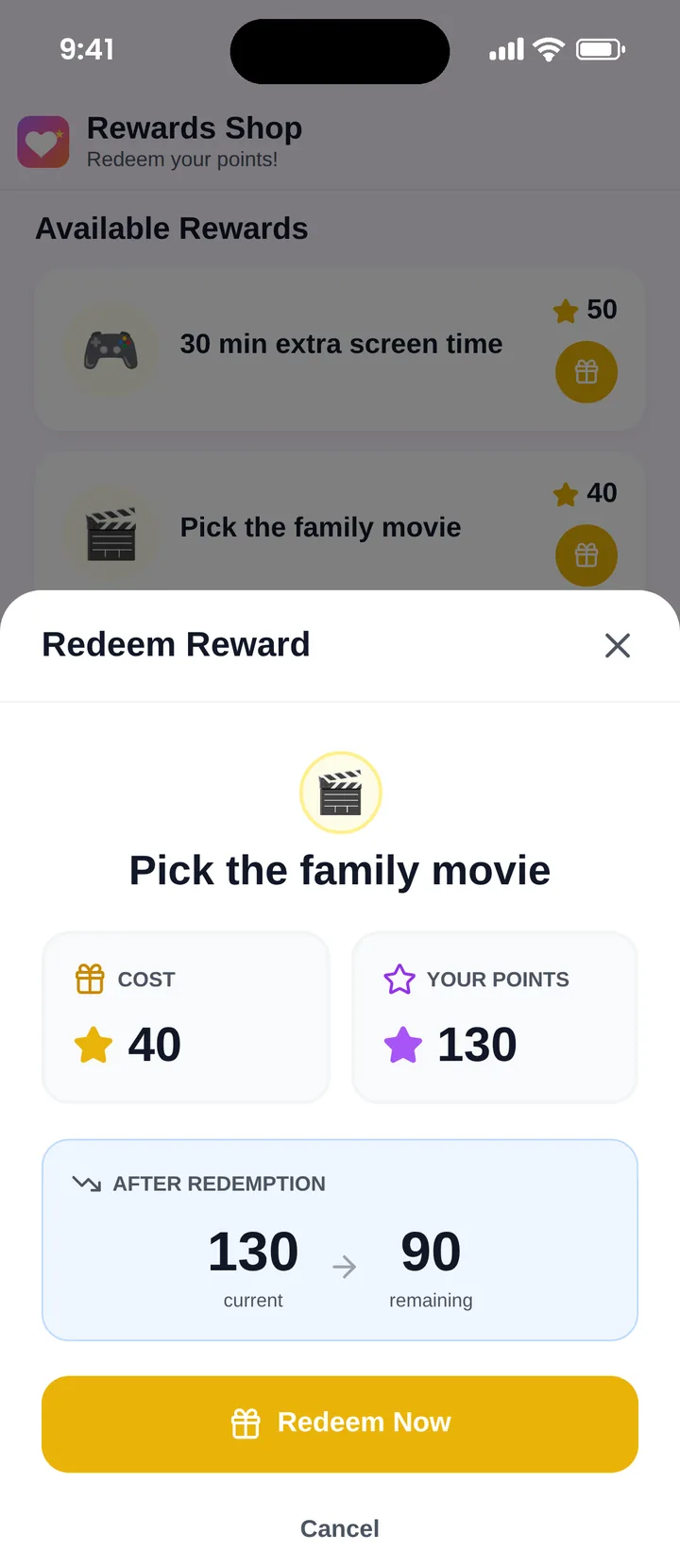
Famiyo is a free family app for iPhone and Android that combines a shared family calendar, chores with points and a rewards shop; kids join with a code, no email needed. For ADHD, the useful part is the rewards shop: you create each reward with a price in points, how many are available and when, so a small reward can be on offer every day and a big one only on weekends. Your child redeems from their own phone and sees how many points they will have left, so the payoff is instant and visible. You get a notification when they redeem. See our list of the best reward chart apps for kids for how apps compare.
A first week to try
Start with two behaviors, a menu of four small rewards and one medium one. Give points the moment each behavior happens. By Thursday, check whether your child has spent any points yet. If not, lower a price. Early wins matter more than the exact numbers.
Frequently asked questions
What rewards work best for kids with ADHD?
Small, immediate rewards work best: a few minutes of a favorite game, choosing the music in the car, a snack, extra time at the playground, or one-on-one time with a parent. Rotate them often, because novelty fades faster for many kids with ADHD.
Should you take points away from a child with ADHD?
Most guidance for parents advises against taking earned points away. Removing something a child already earned feels unfair, can trigger shutdowns, and weakens trust in the system. Skip the points for a missed task and move on to the next chance.
How long should a reward chart last for a child with ADHD?
Plan for a chart to need regular updates. Many families refresh targets and rewards every two to four weeks, because the same chart often loses its pull. A shorter cycle with a fresh reward menu keeps interest higher than one long chart.
Can a reward system replace ADHD treatment?
No. A home reward system is a parenting tool, not a treatment. It can sit alongside whatever plan your child's pediatrician or therapist recommends. Ask them how to match your rewards to your child's specific goals.
How many behaviors should a chart for a child with ADHD include?
Start with two or three. A long list overloads working memory and makes success feel out of reach. Once those behaviors are going well for a few weeks, swap one out or add a new one, keeping the total small.
Try Famiyo With Your Family
Chores with points, a rewards shop for kids and one shared family calendar. Set it up in a couple of minutes.



Free to download • No credit card required • Available on iOS & Android