Sticker Chart for Behavior: Free Printable and How to Use It
A free sticker chart for behavior with five clear goals, how many stickers to give, when to pay out and what to do when it stops working.
By Famiyo Editorial Team4 min read
Free printable
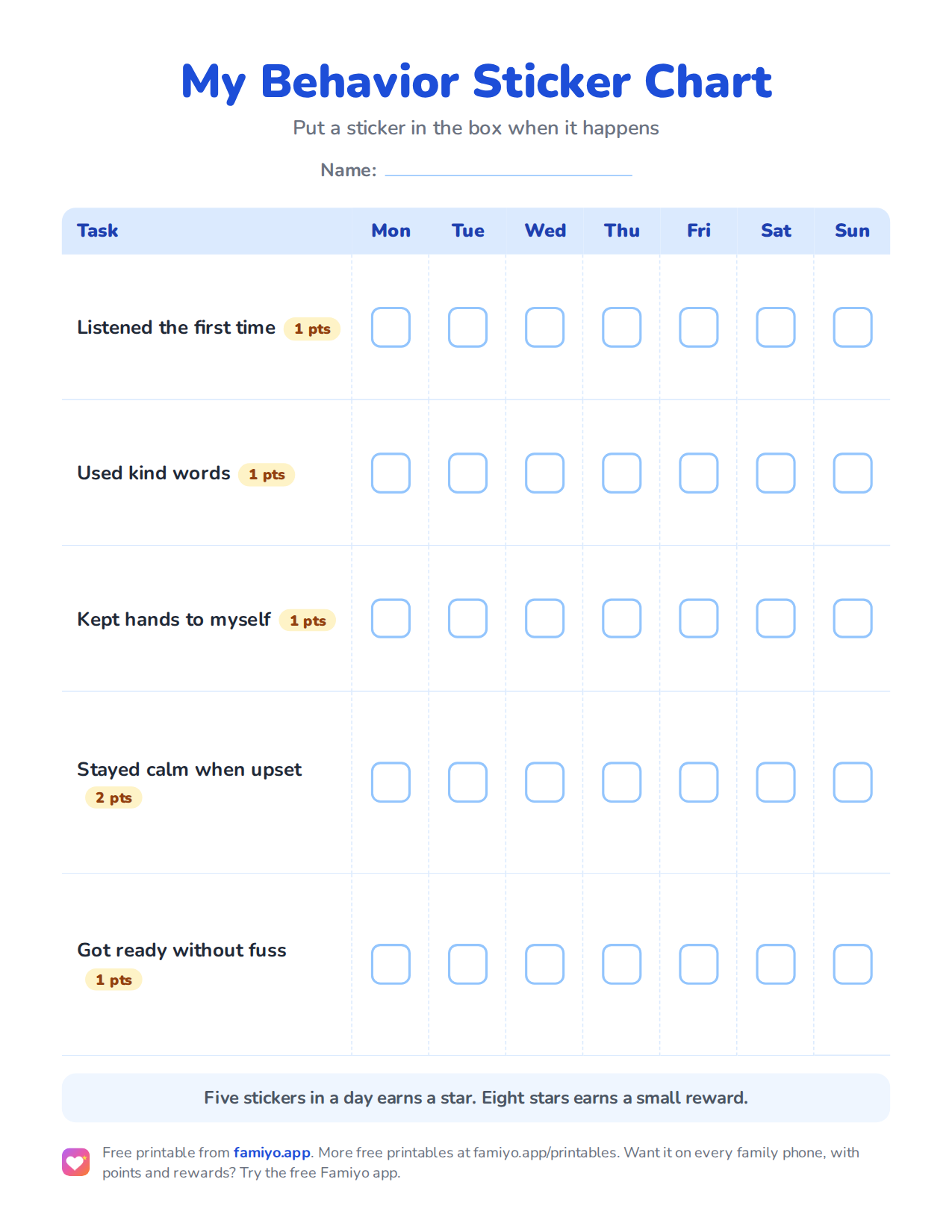
My Behavior Sticker Chart
A weekly chart on one US Letter page. Download the PDF to print it, or save the image to use it on a tablet or in a document.
Free for home, classroom and nonprofit use, see the license. More free printables.
It is 7:40 a.m., the shoes are somewhere, and you have asked three times. A sticker chart gives that morning a plan: a short list of behaviors, a sticker the moment one happens, and a small reward at the end of the row. This page gives you the setup, a printable chart and the rules that make it last past the first week.
What a behavior sticker chart does
A behavior sticker chart makes good moments visible. A child sees a sticker land, sees the row fill and knows what comes next. It works best for ages 3 to 8, when a physical, colorful sign of progress is exciting by itself.
It is not a punishment list. It records wins only. That is the biggest difference between a sticker chart and a rule board, and it is why the calmest households tend to keep it positive.
Choose the behaviors first
Pick two to four, never more. Each should be:
- Visible. You could see it on a video. "Kept hands to myself" passes. "Was nice" doesn't.
- Positive. Say what you want, not what you don't. "Used a calm voice" beats "No yelling".
- Doable today. If your child manages it once in three days, it is a fair target. If it has never happened, break it into a smaller step.
Here are good wordings for common problems.
| Problem | Goal to put on the chart |
|---|---|
| Ignores directions | Listened the first time |
| Hitting or grabbing | Kept hands to myself |
| Whining or yelling | Used a calm voice |
| Slow mornings | Got shoes on after one ask |
| Meltdowns | Took a deep breath and asked for help |
| Mean words | Used kind words with my sibling |
If the target is tidying, see how to get kids to clean their room for step-by-step wording.
How to set up the chart in 6 steps
- Sit down together. Show the chart and read the goals aloud. A child who helped choose the stickers is more invested.
- Explain it in one sentence. "When you do these things, you get a sticker, and stickers turn into a prize."
- Decide the reward in advance. Small rewards work best, like choosing the bedtime story or a trip to the park. Write it at the bottom.
- Put the chart where it is seen. Eye level, on the fridge or the child's door.
- Place the sticker right away. Within a minute of the behavior, say what they did: "You used kind words. Sticker time."
- Count up at a fixed time. After dinner or on Sunday morning, count the row and give the reward.
How many stickers for a reward
Aim for a win in the first two days. A quick reward teaches the whole system, and you can stretch the rows later.
| Age | Goals on chart | Stickers for a reward | Reward timing |
|---|---|---|---|
| 3 to 4 | 1 to 2 | 3 to 5 | Same day or next morning |
| 5 to 6 | 2 to 3 | 5 to 7 | End of the week |
| 7 to 9 | 3 to 4 | 8 to 10 | End of the week, bigger prize |
Our guide on the reward chart for toddlers and its sibling, the sticker chart for toddlers, cover the youngest ages.
The printable behavior chart
The printable below has Monday to Sunday boxes and five goals: listened the first time, used kind words, kept hands to myself, stayed calm when upset, and got ready without fuss. Stayed calm counts for two stickers because it is the hardest. It suits ages 3 to 8. Print a fresh page every week, and swap any goal for one that fits your child.
What to do when the chart stops working
Most charts fade after two or three weeks. That is normal, not failure.
- The goals got easy. Raise the bar a little, or retire a goal that is now a habit.
- The reward is boring. Ask your child what they would like. Keep a short menu.
- You forgot the sticker. Move it to a routine moment you won't miss, like right after breakfast.
- It became a bribe. Never offer stickers during a meltdown. Reward the calm that comes after.
Keep the consequences separate. Rule breaking gets a calm, predictable consequence, like a short break, and the chart stays a place for good news.
Running the chart in Famiyo
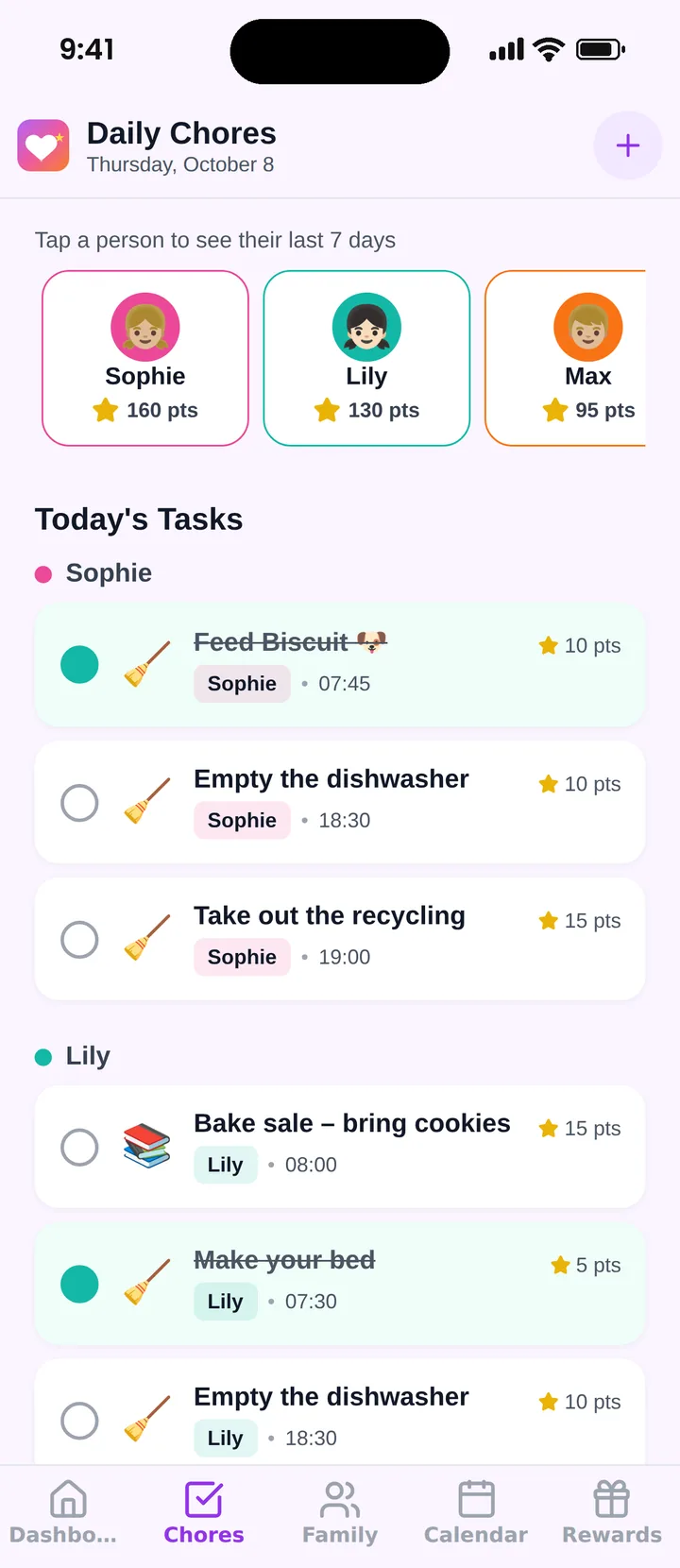
Famiyo is a free family app for iPhone and Android that combines a shared family calendar, chores with points and a rewards shop; kids join with a code, no email needed. If you would rather not peel stickers off the fridge, add each goal as a chore with points and set it to repeat daily. Kids see today's list on their own phone, notifications remind them of new tasks, and everything syncs live between phones. The free plan includes one repeating task, and Premium removes that limit. Compare it with others in our list of the best chore chart apps.
For a younger child, our chore chart for a 3-year-old has more ideas. Print the chart tonight, pick two goals, and put the first sticker on tomorrow morning.
Frequently asked questions
How many behaviors should be on a sticker chart?
Two to four. Each one should be something you can see, like 'used a calm voice' or 'got shoes on after one ask'. More than four spreads a child's attention thin, and a goal like 'be good' is too vague to earn a sticker fairly.
How many stickers before a reward?
For ages 3 to 5, a reward after five stickers keeps it within reach. For ages 6 to 9, seven to ten stickers over a week works. Keep the first reward easy so the child wins early, then stretch the number slowly.
Should I take stickers away for bad behavior?
It is usually better not to. Taking away earned stickers feels like a punishment and can end a child's interest in the chart. Use a separate, calm consequence for rule breaking, and let the chart show only what went well.
How long should a behavior sticker chart last?
Give it two to three weeks of steady use before judging it. When the behavior has become a habit, swap the goal for a new one or move to a less frequent reward rather than dropping the chart overnight.
My child lost interest in the chart. What now?
Change something small: a new set of stickers, a different reward, or a different goal. If interest keeps falling, the goals may be too easy or too hard. Sit with your child and rebuild the chart together.
Try Famiyo With Your Family
Chores with points, a rewards shop for kids and one shared family calendar. Set it up in a couple of minutes.



Free to download • No credit card required • Available on iOS & Android