Chore Chart With Money: How to Set Up Paid Chores
Set up a chore chart for kids with money in four steps: unpaid basics, paid extras, a simple price list and a weekly payout. Free printable included.
By Famiyo Editorial Team3 min read
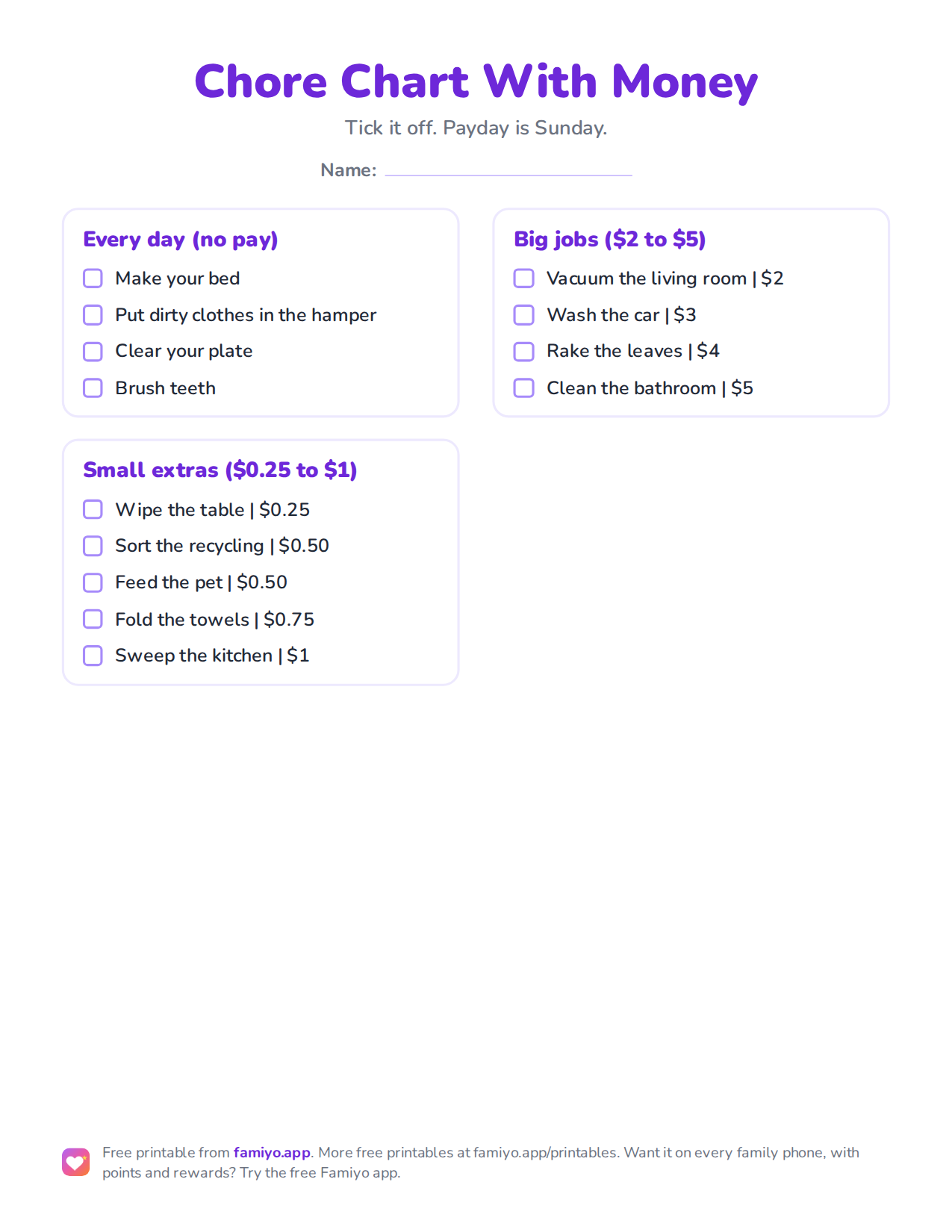
Free printable
Chore Chart With Money
A checklist on one US Letter page. Download the PDF to print it, or save the image to use it on a tablet or in a document.
Free for home, classroom and nonprofit use, see the license. More free printables.
If you've typed "chore chart with money" into a search bar, you probably have one of two problems. Either your kids want to earn something and you don't know how to price it, or you've tried paying for chores and it got messy. This page gives you a setup that stays simple: three tiers, a price list and a free printable.
The three-tier setup
Everything on the chart falls into one of three tiers.
| Tier | Examples | Pay |
|---|---|---|
| Everyday basics | Make the bed, clear your plate, hamper | Nothing |
| Small extras | Wipe the table, sort recycling, feed the pet | $0.25 to $1 |
| Big jobs | Vacuum a room, wash the car, rake leaves | $2 to $5 |
The unpaid tier keeps the chart from teaching a child that everything in the house is a deal. The paid tiers give them a real way to earn, and the choice stays with them. Pay for the extras, and you have a system that's fair and has an exit: your child can skip the paid jobs on a week they don't need the cash.
For more on why many families keep these tiers apart, our guide to a reward system for chores covers the arguments in both directions.
Set it up in four steps
- Write the unpaid basics first. For a 6-year-old, that's three or four things. Agree on them without any money talk.
- List 8 to 10 extra jobs the household would honestly pay someone or be glad to have done. If you would never pay for it, don't list it.
- Price each one. Use $0.25 to $1 for jobs of a few minutes, and $2 to $5 for 30 minutes or more. Round numbers are easier for kids to add.
- Choose a payout day and a method. Sunday evening, cash or jar, same time each week.
The printable at the top of the page follows this format. Print it, cross out what doesn't fit and write in your own jobs and prices. It works best for ages 6 to 12.
Prices by age
Younger kids do shorter jobs, so the prices stay low.
| Age | Typical jobs | Typical price |
|---|---|---|
| 5-7 | Wipe the table, feed the pet, sort socks | $0.25 to $0.50 |
| 8-10 | Load the dishwasher, take out the trash, vacuum one room | $0.50 to $2 |
| 11-13 | Wash the car, clean a bathroom, mow a small lawn | $2 to $5 |
These are starting points. If you're comparing against a weekly allowance, see how it works for a 7-year-old, or what the numbers look like for older kids in how much to pay a 9-year-old for chores.
Keep the quality bar clear
Money brings out the inspector in every parent, so decide up front what "done" means.
- Write a one-line standard next to the job: "Table wiped, no crumbs on the floor."
- Let your child redo it before payday if you spot a miss.
- Pay in full or not at all for a given job. No half-credit.
If your child asks for a raise, treat it as a normal conversation. "You've been doing this one for a month and doing it well. Let's make it $1."
What the chart should not do
A few traps to dodge.
- Don't pay for behavior, such as "no hitting" or "being nice." That's a different chart.
- Don't use the chart to punish. Taking money away after a bad day gets resentful quickly.
- Don't make every chore paid. It teaches kids to ask "what's in it for me?" at every request.
When the money is for something specific, like a toy, kids often get excited about charts for the first time. That's a good moment to talk about saving, and about what spending feels like.
Running a paid chore chart in Famiyo
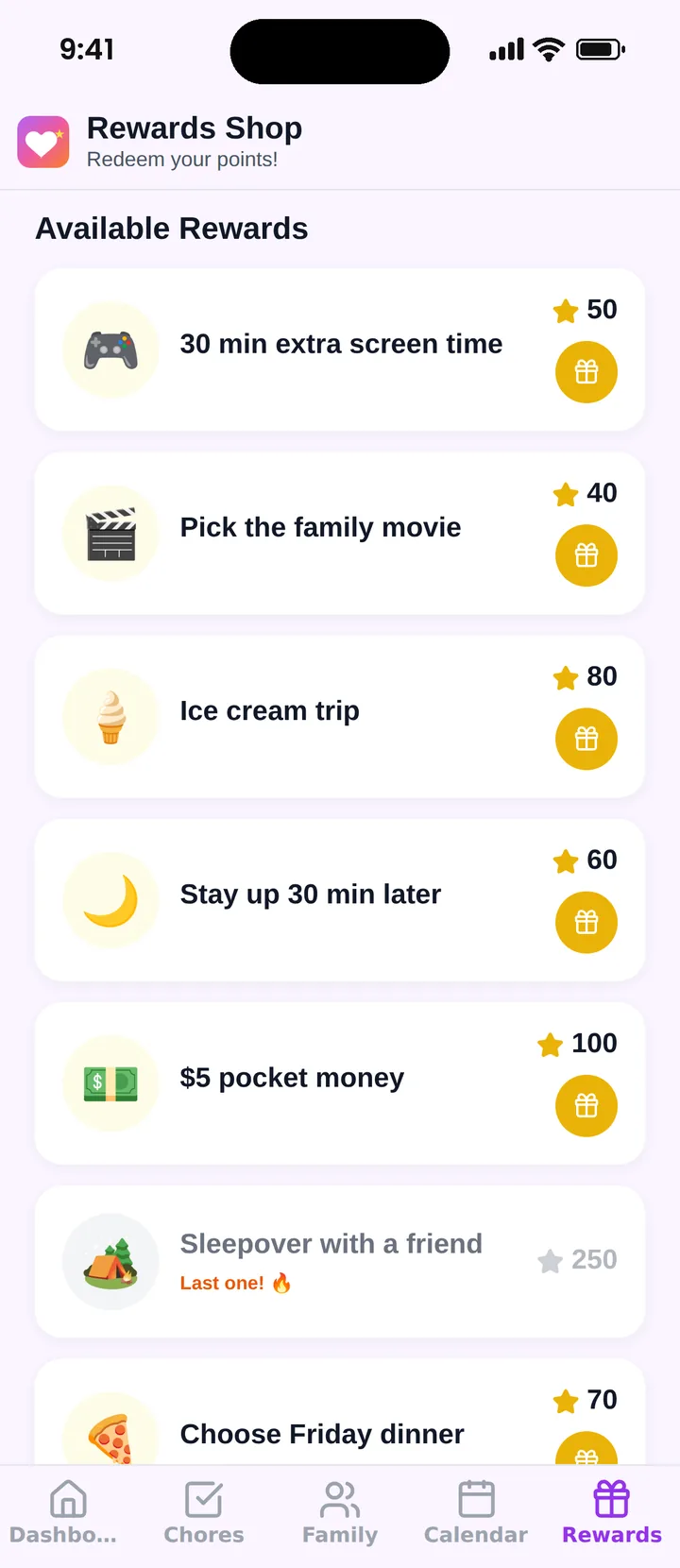
Famiyo is a free family app for iPhone and Android that combines a shared family calendar, chores with points and a rewards shop; kids join with a code, no email needed. The three tiers map straight on. Add the paid extras as chores worth points (a handy rate is 100 points to $1, so a $0.50 job is 50 points), leave the basics at zero or low points, and your child checks tasks off on their own phone. In the rewards shop, set up a "pocket money" reward priced in points, and your child redeems it when they like. The app keeps the count, but real money still changes hands outside it. Compare apps in our best allowance apps for kids list.
Try it for a month
Print the chart, cross out what doesn't suit your house and run it for four weeks. After that, review the prices with your child, since a job that feels fair in week one may need a bump by week five.
Frequently asked questions
Which chores should earn money?
Pay for extra jobs beyond normal family duties, such as washing the car, raking leaves or cleaning out the garage. Everyday chores like making the bed or clearing the table are part of living in a family and usually stay unpaid.
How much should a chore be worth?
A common range is $0.25 to $1 for a small extra job and $2 to $5 for a big one. Match the amount to the time and effort, and keep it modest so the chart doesn't strain your budget.
Do I have to pay in cash?
No. You can pay in cash, add to a savings jar or bank account, or use points that convert to money later. The important part is that the chart shows what was earned and that you pay on the same day each week.
What if my child refuses the paid jobs?
That's allowed, and it's the point of making them optional. They earn nothing that week, and nothing else changes: everyday chores still need doing. Most kids come around when they want something specific to buy.
Try Famiyo With Your Family
Chores with points, a rewards shop for kids and one shared family calendar. Set it up in a couple of minutes.



Free to download • No credit card required • Available on iOS & Android