Pocket Money by Age: What Is Typical
Pocket money by age, in dollars: the $1 per year of age rule, typical weekly ranges from 5 to 14+, and how to adjust for what your child pays for.
By Famiyo Editorial Team3 min read
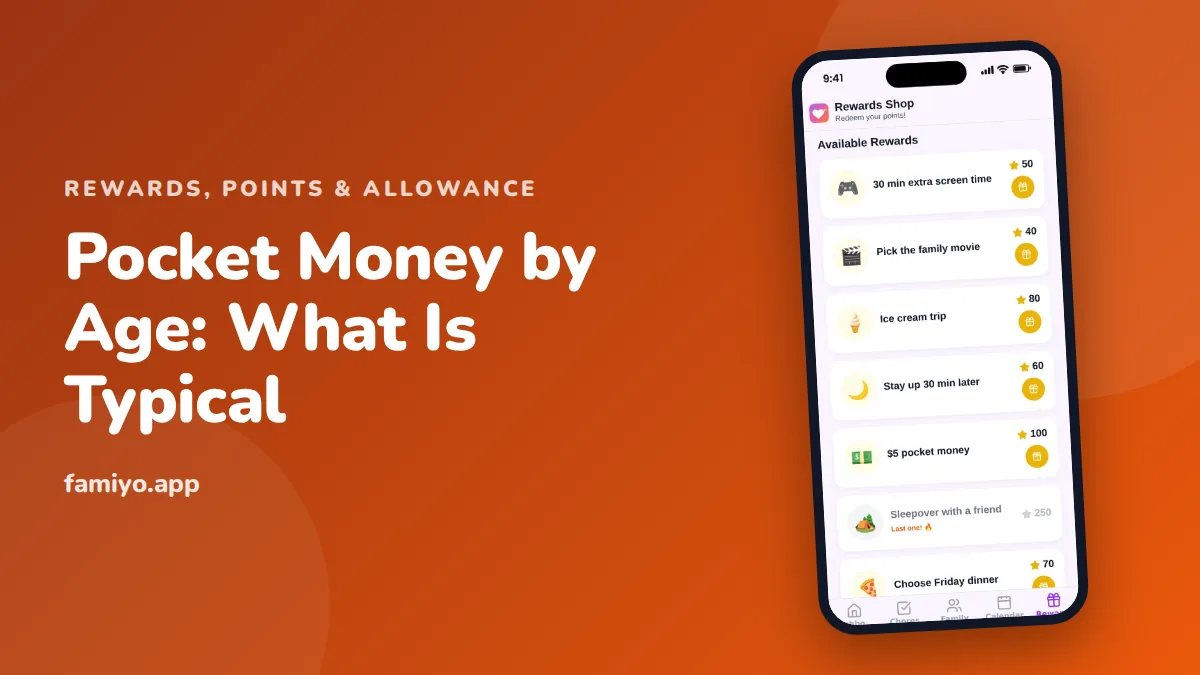
Pocket money is the British word for allowance, and parents search for it both ways. The numbers are the same: how much a child should get each week, and at what age to start. Below are typical amounts in dollars for each age band, the rule of thumb behind them, and the reasons to move your own figure up or down.
How much pocket money should a child get by age?
The most common starting rule is $1 a week for each year of age. An 8-year-old gets $8, a 12-year-old gets $12. It is a rule of thumb, not a standard, and the typical weekly ranges below are a better guide once children are in their teens.
| Age | Typical weekly pocket money | $1 per year rule |
|---|---|---|
| 5 to 7 | $3 to $7 | $5 to $7 |
| 8 to 10 | $7 to $10 | $8 to $10 |
| 11 to 13 | $10 to $15 | $11 to $13 |
| 14 and up | $15 to $25 | $14 and up |
Under 5 there is no typical figure. Most children that age do not yet grasp what money is for, so a sticker or point system fits better. If you want to start with cash anyway, a few coins a week is plenty.
Why the range is so wide
Two families can give very different amounts and both be right. The amount depends mostly on what the child is expected to pay for.
- If pocket money only covers sweets and small toys, the low end of the range is enough.
- If a 14-year-old buys their own snacks, outings with friends and some clothes, the high end or beyond is realistic.
- If your family is tight on budget, a lower amount that you can always pay beats a bigger one that gets missed.
Consistency counts more than size. A smaller amount that arrives every week, on the same day, teaches more than a larger one that arrives when someone remembers.
How much pocket money for a 15 year old?
A 15-year-old sits in the $15 to $25 band for ages 14 and up. The $1 per year rule gives $15, which is the floor. Go toward $25 if they pay for their own phone top-ups, lunches out or clothes, and stay near $15 if you still cover those. We go through that decision in more detail in how much money should a 15 year old have.
For a younger teen, see how much allowance for a 14 year old. For the other end of the range, how much allowance for a 5 year old shows what a first allowance looks like.
Should pocket money be tied to chores?
Both ways work. The cleanest version keeps basic chores (making the bed, clearing your plate, tidying your room) unpaid, since everyone in a household helps, and pays extra for jobs beyond that: $0.25 to $1 for a small extra job and $2 to $5 for a big one. A child who wants more money can earn more.
The other approach pays a flat weekly amount and treats chores as a separate topic. That is simpler and avoids a child deciding a chore is "not worth it", but it gives no link between effort and money. Choose one, tell your child the rule, and don't switch it mid-month.
Spend, save, give
Once a child has pocket money, give it a job. For younger kids a simple split is spend, save, give, for example 50%, 40% and 10%.
| Weekly amount | Spend (50%) | Save (40%) | Give (10%) |
|---|---|---|---|
| $5 | $2.50 | $2.00 | $0.50 |
| $10 | $5.00 | $4.00 | $1.00 |
| $15 | $7.50 | $6.00 | $1.50 |
Teenagers can use a split of their own once they pay for some things themselves. The point is that the money has a plan before it arrives.
Tracking pocket money with points in Famiyo
Famiyo is a free family app for iPhone and Android that combines a shared family calendar, chores with points and a rewards shop; kids join with a code, no email needed. For pocket money, kids earn points for chores and then exchange them for rewards you set up in the shop, and pocket money can be one of those rewards. The default suggestion is that 100 points equal $1. The money itself still changes hands outside the app, so you pay it as you always do.
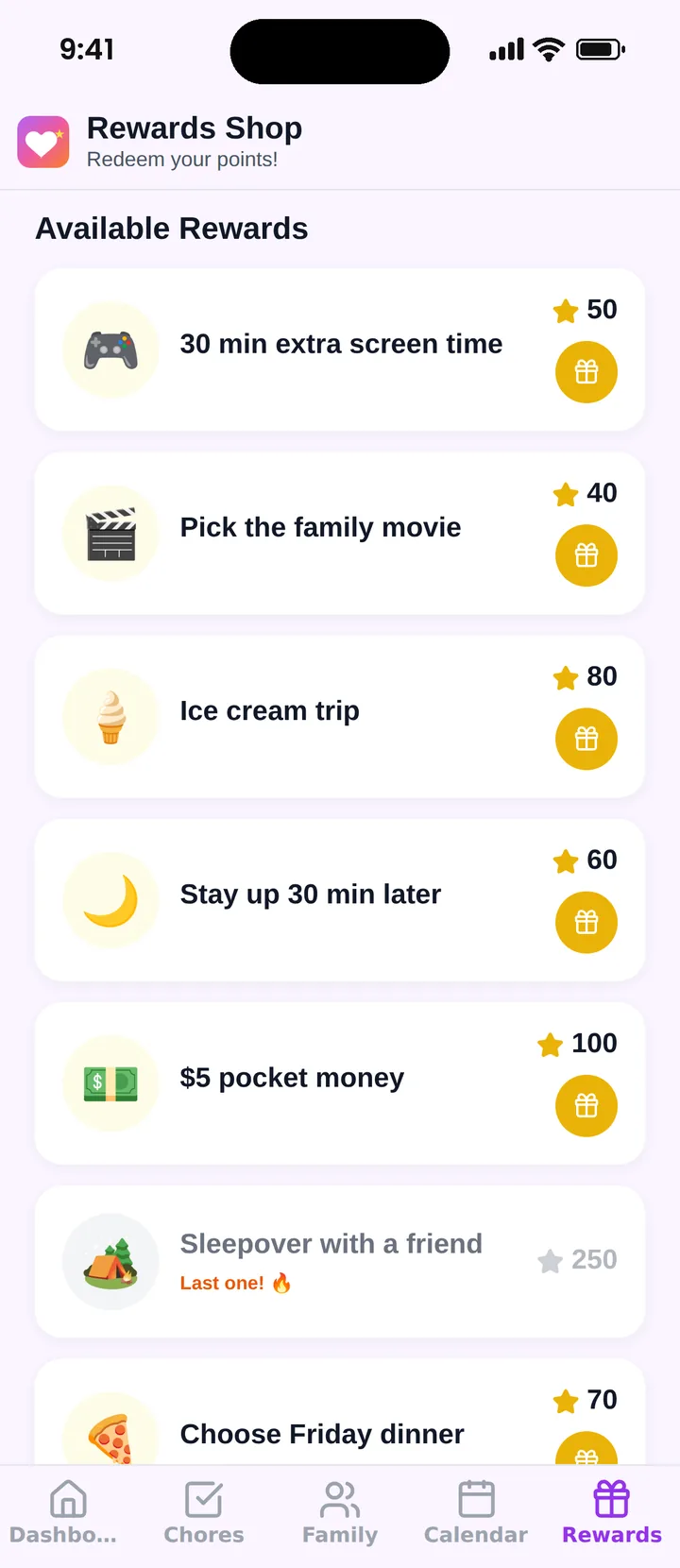
If you are comparing tools, our list of the best allowance apps for kids covers the options.
A first step this week
Pick the age band above that fits your child, choose one amount, and decide what it has to cover. Write both on paper and tell your child on payday, then keep to it for a month before you adjust.
Frequently asked questions
What is the difference between pocket money and allowance?
Nothing important. Pocket money is the British word for what Americans call an allowance: a regular amount of money a child gets to spend, save or give. The same rules of thumb and weekly amounts apply to both.
How much pocket money should a 15 year old get?
Most 15-year-olds fall in the $15 to $25 a week range for ages 14 and up. The $1 per year rule would give $15. Go higher if your teen covers things like snacks, clothes or outings, and lower if you still pay for everything.
At what age should kids start getting pocket money?
Around age 5, when a child understands that coins and bills buy things and can count a small amount. Before that, points or stickers teach the same idea of earning and choosing without the handling of cash.
Should pocket money depend on chores?
Many families keep basic chores unpaid, because they are part of living in a household, and pay a small amount for extra jobs: $0.25 to $1 for a small one, $2 to $5 for a big one. Others tie a base amount to a chore list. Pick one and be consistent.
How should a child split their pocket money?
A simple split for younger kids is spend, save, give: for example 50%, 40% and 10%. On $5 that is $2.50 to spend, $2 to save and $0.50 to give. Teens can use their own split once they cover some costs themselves.
Try Famiyo With Your Family
Chores with points, a rewards shop for kids and one shared family calendar. Set it up in a couple of minutes.



Free to download • No credit card required • Available on iOS & Android