Paid Chores for 12-Year-Olds: Jobs to Earn Money and What to Pay
Paid chores for a 12-year-old: bigger household jobs, simple outside jobs, fair rates and how to track earnings in cash or points without nagging.
By Famiyo Editorial Team5 min read
At 12, your kid has probably outgrown the sticker chart and is starting to notice what things cost. That is a good moment to stretch the chore list. They can do jobs that used to be adult territory, and a bit of earned money gives those jobs a purpose beyond "because I said so."
Below you will find which jobs fit a 12-year-old, what to pay, a sample monthly plan, and how to handle the shift from parent-managed money to something they run themselves.
What changes at 12
The age band for 10 to 12 is about 30 minutes of household work a day, but a 12-year-old tends to be at the high end of it. They can cook a simple meal with an adult nearby, change bed sheets, clean a bathroom and wash the car. By 13 they will be doing their own laundry from start to finish and mowing the lawn.
What also changes is mindset. A 12-year-old wants autonomy and has real opinions about fairness. If you set pay without asking them, expect pushback. If you sit down together and agree on a rate card, they usually hold up their end better.
If your child is a little younger, our article on paid chores for 11-year-olds has smaller jobs and lower stakes.
Bigger household jobs worth paying for
Keep basic upkeep unpaid: their room, their dishes, their laundry basket. Pay for jobs that serve the whole house and take a chunk of time.
| Job | Time | Pay |
|---|---|---|
| Clean a full bathroom, including the tub | 30 to 40 minutes | $3 |
| Mow the lawn (small to medium) | 45 to 60 minutes | $5 |
| Wash and vacuum the car | 45 minutes | $4 |
| Strip, wash and remake all beds | 60 minutes over the day | $4 |
| Cook a simple dinner (pasta, tacos, stir fry) with an adult nearby | 45 minutes | $3 |
| Clear and organize the garage or a storage closet | 60 minutes | $5 |
| Rake or shovel the whole driveway | 45 minutes | $4 |
| Take out all trash and recycling bins to the curb and back | 10 minutes | $0.50 |
| Wipe baseboards or clean inside the fridge | 20 minutes | $1 |
Cooking deserves a note. A kid who cooks one dinner a week is learning a skill that will outlast any allowance, so you might treat the first few meals as practice and pay once they can run the whole thing without help.
Outside jobs that suit a 12-year-old
Formal employment usually starts at 14 or later, depending on your state, so outside work at 12 is informal and local. The rule is simple: an adult you know is in the loop, and the work happens close to home.
- Walking or feeding a neighbor's dog or cat while they are at work.
- Watering plants and collecting mail for a family on vacation.
- Raking leaves or pulling weeds for a relative.
- Helping set up and clean up at a family event.
- Mother's helper work: playing with younger kids while a parent is in the house.
Let the neighbor set the price, but sit down first and talk through what a fair rate looks like so your child doesn't undersell or overcharge. For a longer look at what comes next, see our guide to first jobs for teens.
A sample month of earning
Imagine your 12-year-old wants to save for a $60 pair of headphones. Here is how a month might look if they earn only through extras.
- Week 1: clean a bathroom ($3), wash the car ($4), take out bins twice ($1). Total $8.
- Week 2: mow the lawn ($5), cook one dinner ($3), organize the garage shelf ($5). Total $13.
- Week 3: rake the driveway ($4), strip and wash beds ($4), clean the bathroom ($3). Total $11.
- Week 4: mow the lawn ($5), walk the neighbor's dog all week ($7), wipe baseboards ($1). Total $13.
Month total: $45. Add a few more weekends of jobs and they reach $60 in about six weeks. Seeing that timeline is the lesson. Ask what they want to do if they would rather get there faster, and let them choose the extra jobs.
Setting up the money side
At this age, aim for three buckets: spend, save and give. A reasonable split is 50% spend, 40% save and 10% give. Twelve is also when many kids are ready for a bit more control: let them keep the cash in a locked box or in a bank account in their name with your oversight.
A few habits to set now:
- Write down earnings in one place so no one has to remember.
- Pay on the same day each week.
- Let them make a small bad purchase. A $15 impulse buy teaches more than a lecture.
- Talk through savings goals out loud. Our piece on kids saving money covers goals and what to do when the motivation fades.
- If you want a standard pay scale for the whole family, see how much to pay kids for chores.
Cash, points or both
Paying in cash is simple and concrete. Points are better if your child is just as motivated by screen time, friends over or a late night as they are by dollars. With points, small tasks are worth 5, medium ones 10 and big ones 20, and 100 points equals $1 if you want to convert.
A mixed system tends to work best at 12. Everyday jobs earn points that buy privileges, and the big jobs, like the lawn and the car, pay cash. That keeps cash payments for work that really saves you money, and keeps the daily routine from turning into a negotiation.
How a tech-savvy family tracks it
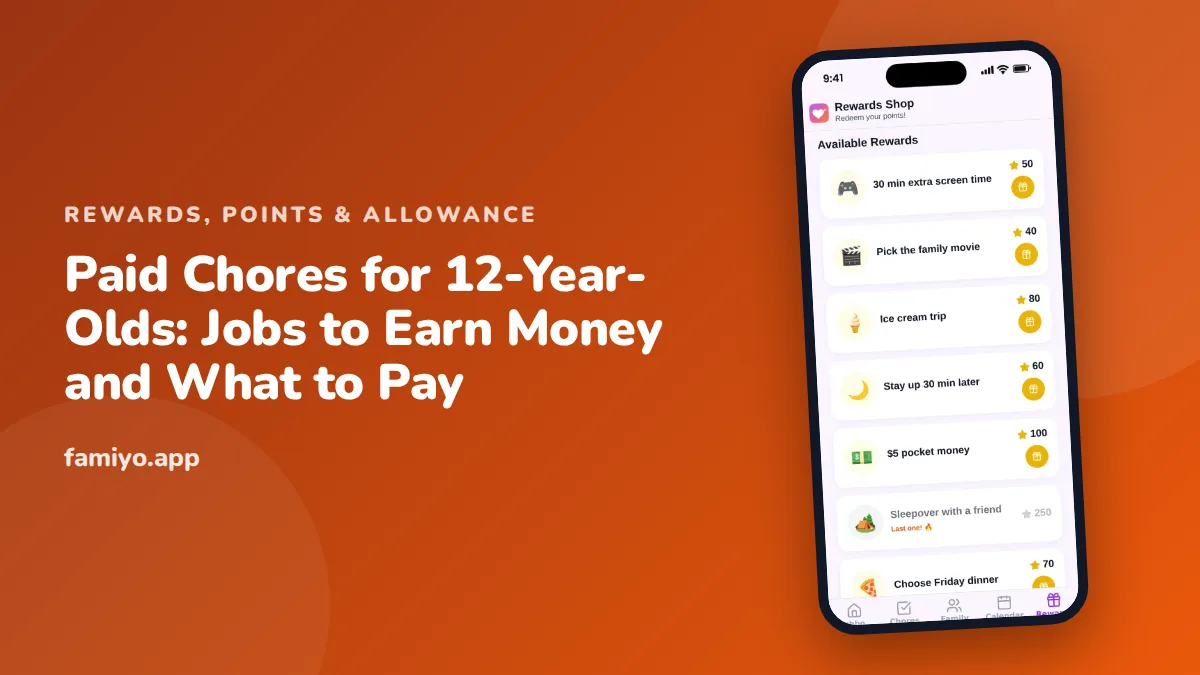
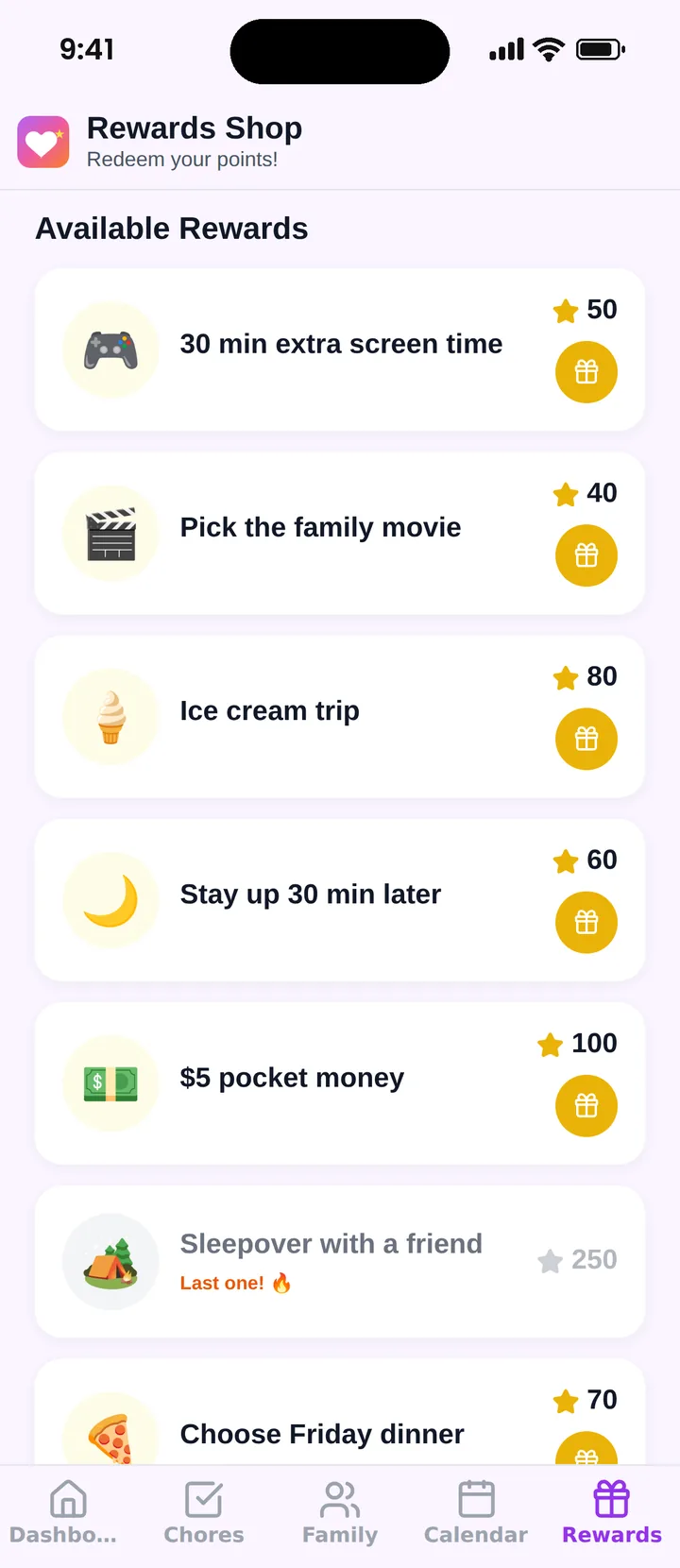
Famiyo is a free family app for iPhone and Android that combines a shared family calendar, chores with points and a rewards shop; kids join with a code, no email needed. You can post a chore with its points, and your 12-year-old checks it off on their own phone, or you approve it first. In the rewards shop, you create rewards with a price in points, how many are available and when, such as a $5 cash payout for 500 points. Kids redeem from their own phone and see what they will have left. The money itself changes hands outside the app. If you are comparing options, our list of the best allowance apps for kids is a good place to start.
What to do when a job is done badly
It will happen. The lawn has stripes of missed grass, or the bathroom mirror is streaked. Don't redo it behind their back, because that teaches them that sloppy work gets quietly fixed. Walk out together, point at the spot and say, "Finish this part and you get the full $5." If they refuse, pay half and say why. Most 12-year-olds fix the second job faster than the first, and they remember the standard next time.
It also helps to show the job once before you pay for it. Ten minutes of "here is how I do the windows" saves a lot of disappointment.
Keep the rate card honest
Review prices every few months. Jobs that used to take an hour may take 30 minutes now, and your child will notice if the pay hasn't changed. Pick one job to add to the rate card this week, write down the price together, and let your 12-year-old sign it.
Frequently asked questions
How much should a 12-year-old make doing chores?
Typical weekly totals for ages 11 to 13 run $10 to $15, whether that comes from an allowance, paid extras or a mix. A 12-year-old doing two or three big jobs at $2 to $5 each will land near the top of that range.
What chores can a 12-year-old do to earn money at home?
Mow the lawn, wash the car, deep-clean a bathroom, change and wash the bed sheets for the whole house, cook a simple dinner with an adult nearby, or organize the garage. Anything that takes real effort and happens only now and then qualifies.
Can a 12-year-old get a real job?
Formal jobs in the US generally start at 14 or later depending on the state, so at 12 the options are informal: pet sitting, yard work for neighbors or helping at a family event. Keep an adult involved and check your local rules.
Should a 12-year-old be paid for homework or good grades?
Most families keep school separate from household pay. Homework is the child's own job, and paying for grades can shift attention from learning to the reward. Chores are a cleaner place to attach money, because the work benefits the whole household.
Try Famiyo With Your Family
Chores with points, a rewards shop for kids and one shared family calendar. Set it up in a couple of minutes.



Free to download • No credit card required • Available on iOS & Android